Back

Constant-Pressure Calorimetry quiz

Control buttons has been changed to "navigation" mode.
1/15
  • What is the main purpose of calorimetry in chemistry?

    Calorimetry is used to measure the amount of heat absorbed or released during a chemical or physical process.
  • Why is a coffee cup calorimeter considered a constant-pressure calorimeter?

    Because it is open to the atmosphere, so the pressure remains constant during the experiment.
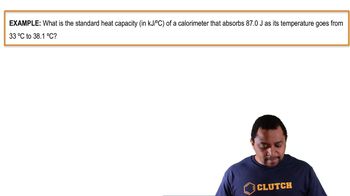
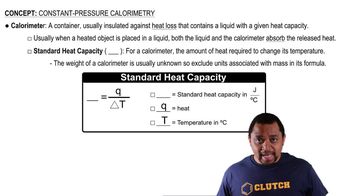
  • What is the standard heat capacity (C) of a calorimeter?

    It is the amount of heat required to change the temperature of the calorimeter by one degree Celsius.
  • Why is the mass of the calorimeter usually excluded from calculations?

    Because the mass of the calorimeter is typically unknown, so only its heat capacity is used in calculations.
  • What is the formula for calculating heat using specific heat capacity?

    The formula is Q = mcΔT, where Q is heat, m is mass, c is specific heat capacity, and ΔT is temperature change.
  • How is the heat absorbed by the calorimeter calculated?

    It is calculated using Q = CΔT, where C is the calorimeter's heat capacity and ΔT is the temperature change.
  • What units are typically used for the calorimeter's heat capacity?

    The units are usually joules per degree Celsius (J/°C).
  • What must you ensure about the units when performing calorimetry calculations?

    You must ensure all units are consistent, especially for temperature and heat, to get accurate results.
  • What components are typically found in a coffee cup calorimeter?

    A coffee cup calorimeter usually contains a thermometer, a styrofoam cup and lid, water, and a stirrer.
  • What happens when a heated object is placed in the calorimeter?

    Both the liquid and the calorimeter absorb the heat released by the object.
  • How is the heat lost by the object related to the heat gained by the water and calorimeter?

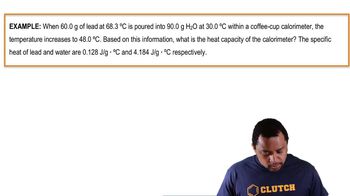
    The heat lost by the object (−Q) equals the heat gained by the water plus the heat gained by the calorimeter.
  • What is the expanded equation for constant-pressure calorimetry involving all components?

    It is: −mcΔT (object) = mcΔT (water) + CΔT (calorimeter).
  • Why is a coffee cup calorimeter insulated?

    It is insulated to minimize heat loss to the surroundings, ensuring accurate measurement of heat transfer.
  • What role does the thermometer play in a coffee cup calorimeter?

    The thermometer measures the temperature change, which is needed to calculate heat transfer.
  • If temperature is given in Kelvin, what must you do with the units in your calculations?

    You must ensure all temperature values are in Kelvin and that units match throughout the calculation.