Back

Chemistry Gas Laws: Combined Gas Law quiz

Control buttons has been changed to "navigation" mode.
1/15
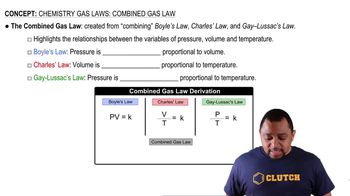
  • What three individual gas laws are combined to form the combined gas law?

    Boyle's Law, Charles's Law, and Gay-Lussac's Law are combined to form the combined gas law.
  • According to Boyle's Law, how are pressure and volume related?

    Pressure and volume are inversely proportional according to Boyle's Law.
  • What does Charles's Law state about the relationship between volume and temperature?

    Charles's Law states that volume is directly proportional to temperature.
  • How does Gay-Lussac's Law relate pressure and temperature?

    Gay-Lussac's Law states that pressure is directly proportional to temperature.
  • Write the mathematical form of the combined gas law.

    The combined gas law is written as PV/T = constant.
  • How can the combined gas law be used to compare two different sets of conditions?

    It can be used as (P1V1)/T1 = (P2V2)/T2 to compare two sets of pressure, volume, and temperature.
  • What does the constant 'k' represent in the combined gas law equation?

    The constant 'k' represents a constant value for a given amount of gas.
  • If the temperature of a gas increases while pressure remains constant, what happens to the volume according to the combined gas law?

    The volume increases as temperature increases if pressure is constant.
  • If the volume of a gas decreases and temperature remains constant, what happens to the pressure?

    The pressure increases as volume decreases if temperature is constant.
  • Why is the combined gas law important in chemistry and physics?

    It allows prediction of gas behavior under varying pressures, volumes, and temperatures.
  • What must remain constant for the combined gas law to apply?

    The amount of gas (number of moles) must remain constant.
  • How does the combined gas law help in solving real-world problems?

    It helps predict how gases will respond to changes in pressure, volume, or temperature in practical situations.
  • What variable is in the denominator in the combined gas law equation?

    Temperature (T) is in the denominator.
  • If both pressure and temperature increase, what generally happens to the volume if the amount of gas is constant?

    The change in volume depends on the relative changes in pressure and temperature.
  • What is the significance of using absolute temperature (Kelvin) in the combined gas law?

    Absolute temperature ensures proportional relationships and prevents division by zero.