Back

Classification of Ligands quiz

Control buttons has been changed to "navigation" mode.
1/15
  • What is a ligand in coordination chemistry?

    A ligand is a Lewis base that donates at least one lone pair to a metal cation.
  • How are ligands classified based on donor atoms?

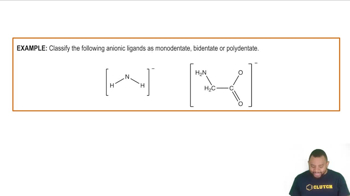
    Ligands are classified as monodentate (one donor atom), bidentate (two donor atoms), or polydentate (more than two donor atoms).
  • What is a monodentate ligand?

    A monodentate ligand has only one donor atom that can donate a lone pair to the central metal.
  • Name three common monodentate ligands.

    Hydroxide, ammonia, and cyanide are common monodentate ligands.
  • What is a bidentate ligand?

    A bidentate ligand has two donor atoms, each capable of donating a lone pair, separated by at least two other atoms.
  • Give an example of a bidentate ligand.

    Ethylenediamine (en) is a bidentate ligand with two nitrogen donor atoms separated by two carbon atoms.
  • What is a polydentate ligand?

    A polydentate ligand has more than two donor atoms that can form multiple bonds with a metal cation.
  • What is the most famous polydentate ligand mentioned in the lesson?

    EDTA (Ethylene Diaminetetra Acetate) is the most famous polydentate ligand, with six donor atoms.
  • What is a chelating agent?

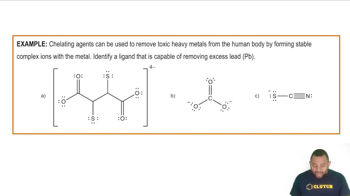
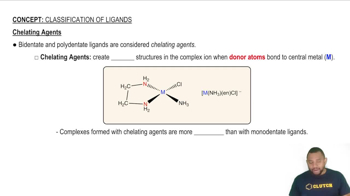
    Chelating agents are bidentate or polydentate ligands that create ring structures in a complex ion by bonding to the central metal.
  • Why are complexes formed with chelating agents more stable than those with monodentate ligands?

    Chelating agents form ring structures, which increase the stability of the complex compared to monodentate ligands.
  • What ring sizes are most common in chelate complexes?

    Five and six-membered rings are most common in chelate complexes formed by bidentate and polydentate ligands.
  • How do you determine the number of donor atoms in a ligand?

    Count the atoms with lone pairs that can donate to the metal, ensuring donor atoms are separated by at least two other atoms.
  • What rule helps identify donor atoms in a ligand?

    Atoms with a negative charge are considered donor atoms, and donor atoms must be separated by two or more atoms.
  • What is the donor atom in hydroxide and cyanide ligands?

    In hydroxide, the oxygen is the donor atom; in cyanide, the carbon with the negative charge is the donor atom.
  • What is the significance of EDTA in everyday products?

    EDTA is used as a preservation agent in many types of foods and is commonly found in food packaging.