Skip to main content
General Chemistry
My Course
Learn
Exam Prep
AI Tutor
Study Guides
Textbook Solutions
Flashcards
Explore
Try the app
My Course
Learn
Exam Prep
AI Tutor
Study Guides
Textbook Solutions
Flashcards
Explore
Try the app
Back
Calculating K For Overall Reaction quiz
You can tap to flip the card.
What is the equilibrium constant (Keq) for an overall reaction when multiple steps are involved?
You can tap to flip the card.
👆
What is the equilibrium constant (Keq) for an overall reaction when multiple steps are involved?
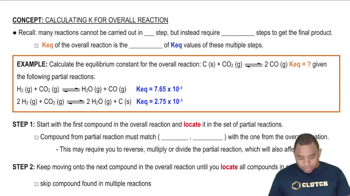
It is the product of the equilibrium constants of each individual step in the reaction sequence.
Track progress
Control buttons has been changed to "navigation" mode.
1/15
Related flashcards
Related practice
Recommended videos
Calculating K For Overall Reaction definitions
Calculating K For Overall Reaction
10 Terms
Calculating K for Overall Reaction
16. Chemical Equilibrium
5 problems
Topic
Jules
Le Chatelier's Principle
16. Chemical Equilibrium
7 problems
Topic
Jules
16. Chemical Equilibrium - Part 1 of 2
5 topics
13 problems
Chapter
Jules
16. Chemical Equilibrium - Part 2 of 2
5 topics
13 problems
Chapter
Jules
Guided course
07:02
Overall Reaction Equilibrium Constant
9
views
Terms in this set (15)
Hide definitions
What is the equilibrium constant (Keq) for an overall reaction when multiple steps are involved?
It is the product of the equilibrium constants of each individual step in the reaction sequence.
What must you check for each compound when matching it from the overall reaction to the partial reactions?
You must ensure the compound matches in number (coefficient) and phase (state of matter).
What should you do if a compound appears in more than one partial reaction?
Skip that compound when matching compounds from the overall reaction to the partial reactions.
What happens to the equilibrium constant if you reverse a partial reaction?
You take the inverse (reciprocal) of the equilibrium constant for that reaction.
How do you adjust the equilibrium constant if you multiply a partial reaction by a coefficient?
You raise the equilibrium constant to the power of that coefficient.
What is a reaction intermediate?
A reaction intermediate is a compound that appears as a reactant in one step and as a product in another, and cancels out when combining reactions.
What is the final step in calculating the overall equilibrium constant after manipulating the partial reactions?
Multiply the equilibrium constants of the manipulated partial reactions to obtain the overall Keq.
Why is it important to match the phase of compounds when aligning partial reactions?
Because the equilibrium constant depends on the phase, and mismatched phases can lead to incorrect calculations.
What do you do with intermediates when combining partial reactions?
You cancel out intermediates that appear on both sides of the combined reactions.
If you reverse a reaction with Keq = 2.75 × 10⁻¹, what is the new Keq?
The new Keq is the reciprocal, so 1 / (2.75 × 10⁻¹) = 3.6363.
If you multiply a reaction with Keq = 0.765 by 2, what is the new Keq?
The new Keq is (0.765)² = 0.585225.
What does it mean if, after combining and canceling, you recreate the overall reaction?
It means you have correctly manipulated and combined the partial reactions.
How do you find the overall Keq if you have two manipulated partial reactions with Keq values of 0.585225 and 3.6363?
Multiply the two values: 0.585225 × 3.6363 = 2.128 (rounded to 2.13 for three significant figures).
Why is calculating the overall equilibrium constant important in chemistry?
It helps predict the reaction's behavior and is crucial for understanding chemical kinetics and thermodynamics.
What should you do if the coefficients in the partial reaction do not match those in the overall reaction?
Multiply the entire partial reaction by the necessary factor to match the coefficients, adjusting the Keq accordingly.
 BackBack
 07:02
07:02