Back

Calculate Oxidation Numbers quiz

Control buttons has been changed to "navigation" mode.
1/15
  • What is the oxidation number of an element in its natural or standard state?

    The oxidation number is zero for an element in its natural or standard state.
  • What is the oxidation number of Group 1A elements when bonded to other elements?

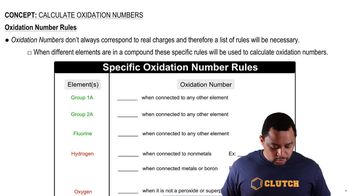
    Group 1A elements have an oxidation number of +1 when bonded to other elements.
  • What is the oxidation number of Group 2A elements in compounds?

    Group 2A elements have an oxidation number of +2 in compounds.
  • What is the oxidation number of Group 3A elements in compounds?

    Group 3A elements have an oxidation number of +3 in compounds.
  • What is the oxidation number of Group 5A, 6A, and 7A elements in compounds?

    Group 5A elements are -3, Group 6A are -2, and Group 7A are -1 in compounds.
  • What is the oxidation number of noble gases in their natural state?

    Noble gases typically have an oxidation number of zero due to their stability.
  • What is the oxidation number of a monoatomic ion?

    The oxidation number of a monoatomic ion is equal to its charge.
  • What is the oxidation number of hydrogen when bonded to nonmetals?

    Hydrogen has an oxidation number of +1 when bonded to nonmetals.
  • What is the oxidation number of hydrogen when bonded to metals or boron?

    Hydrogen has an oxidation number of -1 when bonded to metals or boron.
  • What is the usual oxidation number of oxygen in compounds (not peroxides or superoxides)?

    Oxygen usually has an oxidation number of -2 in compounds, unless it is in a peroxide or superoxide.
  • What is the oxidation number of oxygen in peroxides?

    In peroxides, oxygen has an oxidation number of -1.
  • What is the oxidation number of oxygen in superoxides?

    In superoxides, oxygen has an oxidation number of -1/2.
  • What is the oxidation number of Group 7A elements (like Cl, Br, I) in compounds, except when bonded to oxygen?

    Group 7A elements have an oxidation number of -1, except when bonded to oxygen.
  • What are the four steps to determine the oxidation number of a non-listed element in a compound?

    Assign the unknown as x, write known oxidation numbers, distribute subscripts, and set the sum equal to the compound's charge.
  • How do you identify if an element's oxidation number is not zero in a compound?

    If the element is not in its natural state or is part of a compound or ion, its oxidation number is not zero and must be determined using rules.