Back

Boron Family Reactions quiz

Control buttons has been changed to "navigation" mode.
1/15
  • What is the common name for group 3A elements in the periodic table?

    Group 3A elements are commonly known as the Boron family.
  • How many valence electrons do Boron family elements have?

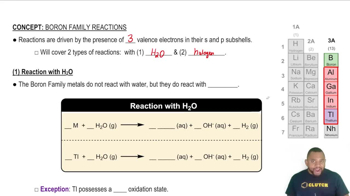
    Boron family elements have three valence electrons in their s and p subshells.
  • Do Boron family metals react with liquid water or steam?

    Boron family metals react with steam, not with liquid water.
  • What are the products when group 3A metals react with steam?

    The products are the metal ion (M³⁺), hydroxide ion (OH⁻), and hydrogen gas (H₂).
  • What is the predominant oxidation state for most group 3A elements?

    Most group 3A elements have a predominant oxidation state of +3.
  • Which group 3A element prefers a +1 oxidation state?

    Thallium prefers a +1 oxidation state.
  • How does thallium’s reaction with steam differ from other group 3A metals?

    Thallium forms Tl⁺ ions instead of M³⁺ ions when reacting with steam.
  • What is produced when thallium reacts with steam?

    Thallium produces Tl⁺, hydroxide ion (OH⁻), and hydrogen gas (H₂).
  • What type of bonding is possible in Boron family elements?

    Boron family elements can exhibit metallic bonding and covalent network bonding.
  • What is the general formula for halide solids formed by most group 3A elements?

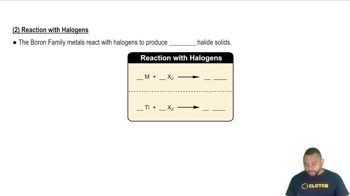
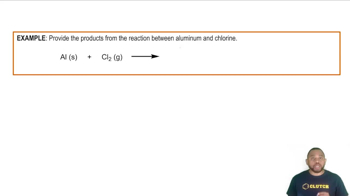
    The general formula is MX₃, where M is the metal and X is the halogen.
  • What is the formula for halide solids formed by thallium?

    Thallium forms halide solids with the formula TlX.
  • Why do Boron family elements form MX₃ with halogens?

    Because the metal is +3 and the halogen is -1, three halogen ions are needed to balance one metal ion.
  • What is the charge of halogens in these reactions?

    Halogens have a charge of -1 in these reactions.
  • What is always produced when Boron family metals react with halogens?

    An ionic halide solid is always produced.
  • Why is balancing equations important in Boron family reactions?

    Balancing ensures the correct stoichiometry and reflects the preferred oxidation states of the elements.