Back

Band of Stability: Overview quiz

Control buttons has been changed to "navigation" mode.
1/15
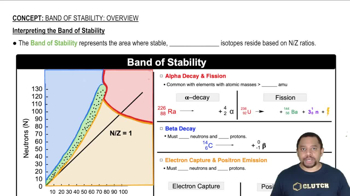
  • What does the band of stability represent on a neutron-to-proton plot?

    It represents the area where stable, non-radioactive isotopes reside based on their neutron-to-proton ratios.
  • What type of decay is common in elements with atomic masses greater than 209 AMU?

    Alpha decay and nuclear fission are common in these heavy elements.
  • What is the result of radium-226 undergoing alpha decay?

    It emits an alpha particle and becomes radon-222.
  • What happens during nuclear fission of a heavy element?

    The nucleus splits into two daughter isotopes, releases three neutrons, and produces a large amount of energy.
  • Where on the neutron-to-proton plot does beta decay typically occur?

    Beta decay typically occurs to the left of the band of stability, where there is an excess of neutrons.
  • What is the purpose of beta decay in neutron-rich isotopes?

    Beta decay decreases the number of neutrons and increases the number of protons to move toward stability.
  • What is the product when carbon-14 undergoes beta decay?

    It becomes nitrogen-14.
  • What decay processes occur in isotopes with excess protons?

    Electron capture and positron emission occur in isotopes with excess protons.
  • What is the result of cesium-131 undergoing electron capture or positron emission?

    It becomes xenon-131.
  • What is the main goal of radioactive decay for unstable isotopes?

    The main goal is to reach a stable neutron-to-proton ratio within the band of stability.
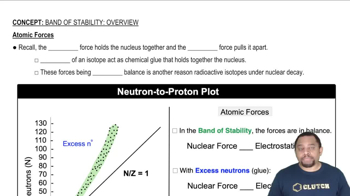
  • What force holds the nucleus together?

    The nuclear force holds the nucleus together.
  • What force tends to pull the nucleus apart?

    The electrostatic force, due to repulsion between protons, tends to pull the nucleus apart.
  • How do neutrons contribute to nuclear stability?

    Neutrons act as a 'chemical glue,' reducing repulsion between protons and helping to stabilize the nucleus.
  • What happens to the balance of forces in a nucleus with excess neutrons?

    The nuclear force is greater than the electrostatic force, helping to hold the nucleus together.
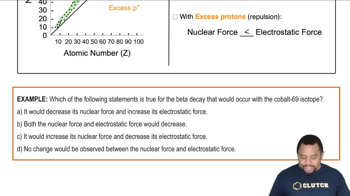
  • What happens to the balance of forces in a nucleus with excess protons?

    The electrostatic force becomes greater than the nuclear force, increasing the tendency for the nucleus to break apart.