Back

Band of Stability: Electron Capture & Positron Emission quiz

Control buttons has been changed to "navigation" mode.
1/15
  • What is the main goal of electron capture and positron emission for isotopes to the right of the valley of stability?

    The main goal is to convert protons into neutrons, increasing the neutron-to-proton ratio and moving the isotope toward greater stability.
  • What happens to the number of protons during electron capture or positron emission?

    The number of protons decreases as a proton is converted into a neutron.
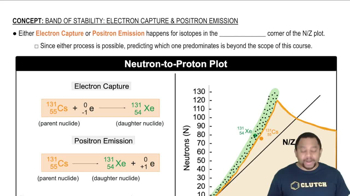
  • What is the daughter product when cesium-131 undergoes electron capture?

    The daughter product is xenon-131.
  • What is the daughter product when cesium-131 undergoes positron emission?

    The daughter product is also xenon-131.
  • Why do isotopes to the right of the valley of stability undergo electron capture or positron emission?

    They have an excess of protons and need to increase their neutron-to-proton ratio to become more stable.
  • What is emitted during positron emission?

    A positron is emitted from the nucleus.
  • What is absorbed during electron capture?

    An electron is absorbed by the nucleus.
  • Do electron capture and positron emission always produce different daughter nuclei?

    No, both processes can produce the same daughter nucleus, as seen with cesium-131 forming xenon-131.
  • Is it possible to predict which process, electron capture or positron emission, will predominate for a specific isotope?

    No, predicting which process predominates is complex and beyond the scope of this course.
  • What region of the neutron-to-proton plot do isotopes that undergo electron capture or positron emission occupy?

    They are located to the right of the valley of stability.
  • What is the effect of both electron capture and positron emission on the neutron-to-proton ratio?

    Both processes increase the neutron-to-proton ratio.
  • What is the purpose of converting protons into neutrons in unstable isotopes?

    It helps the isotope move closer to the valley of stability, making it more stable.
  • What is the 'valley of stability' in the context of nuclear chemistry?

    It is the region on the neutron-to-proton plot where stable isotopes are found.
  • Why is the choice between electron capture and positron emission complex?

    Because many isotopes exist and the factors influencing the preferred process are numerous and varied.
  • What do electron capture and positron emission have in common?

    Both processes transform a proton into a neutron, helping the nucleus achieve a more stable configuration.