Back

Atomic Radius & Density of Transition Metals quiz

Control buttons has been changed to "navigation" mode.
1/15
  • How does the atomic radius of main group elements change across a period and up a group?

    The atomic radius decreases from left to right across a period and decreases as you go up a group.
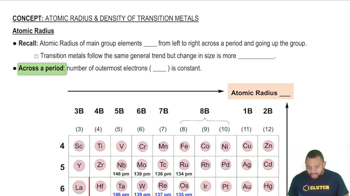
  • How does the trend in atomic radius for transition metals compare to main group elements?

    Transition metals follow a similar trend, but the change in atomic radius is more gradual than in main group elements.
  • Why is the change in atomic radius among transition metals more gradual?

    Because the number of electrons in the outer s orbital remains constant while additional electrons are added to inner d or f orbitals.
  • What is the principal quantum number (n) associated with in transition metals?

    It represents the shell number of the outermost electrons, which is constant across a period for transition metals.
  • Where are additional electrons added as you move across a period in transition metals?

    They are added to the inner d or f orbitals, not the outermost shell.
  • What is the lanthanide contraction?

    It is the phenomenon where the atomic radius of period 6 transition metals is smaller than expected due to poor shielding by 4f electrons, increasing effective nuclear charge.
  • How does the lanthanide contraction affect the size of period 6 transition metals?

    It causes their atomic size to be relatively constant or only slightly smaller compared to period 5 transition metals.
  • What is effective nuclear charge (Z_eff)?

    It is the attractive force between the nucleus and the surrounding electrons.
  • Why do 4f electrons cause an increase in effective nuclear charge?

    Because 4f electrons shield poorly, allowing the nucleus to pull outer electrons closer.
  • How does the density of transition metals change across a period?

    Density increases across a period because mass increases while volume remains relatively constant.
  • How does the density of transition metals change down a group?

    Density increases more significantly down a group due to a greater increase in mass while volume stays about the same.
  • What is the formula for density?

    Density equals mass divided by volume (density = mass/volume).
  • Why does the volume of transition metals stay relatively constant across a period or down a group?

    Because the outer shell size does not increase significantly, even as more electrons are added to inner orbitals.
  • What happens to the mass of transition metals as you move down a group?

    The mass increases as you move from lighter to heavier elements.
  • Why does increasing mass with relatively constant volume lead to higher density in transition metals?

    Because density is mass divided by volume, so if mass increases and volume stays the same, density increases.