Back

Aldehydes and Ketones Reactions quiz

Control buttons has been changed to "navigation" mode.
1/15
  • What is the main function of sodium borohydride (NaBH4) in reduction reactions involving aldehydes and ketones?

    Sodium borohydride acts as a reducing agent, adding hydrogen atoms to the carbonyl carbon and oxygen, converting aldehydes and ketones into alcohols.
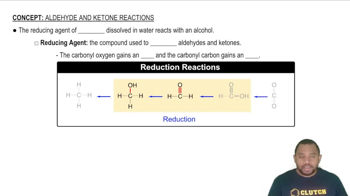
  • During the reduction of a carbonyl group, which atoms gain hydrogen atoms?

    Both the carbonyl carbon and the carbonyl oxygen gain hydrogen atoms during the reduction process.
  • What happens to the pi bond in the carbonyl group during reduction?

    The pi bond is lost because the carbon can only form four bonds, so it is replaced by a new carbon-hydrogen bond.
  • Why does the oxygen atom in a carbonyl group gain a hydrogen during reduction?

    Oxygen prefers to have two bonds, so when the pi bond is lost, it gains a hydrogen to maintain its preferred bonding.
  • What type of compounds are typically reduced to alcohols in general chemistry?

    Aldehydes and ketones are typically reduced to alcohols.
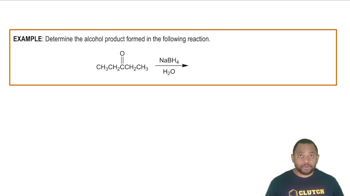
  • What is the result of reducing an aldehyde or ketone with NaBH4?

    The result is the formation of an alcohol.
  • What is the maximum number of bonds that a carbon atom can form?

    A carbon atom can form a maximum of four bonds.
  • What is the ideal number of bonds for an oxygen atom in these reactions?

    Oxygen ideally forms two bonds.
  • What is the general mechanism for reducing a carbonyl group?

    The mechanism involves adding a hydrogen to both the carbonyl carbon and oxygen, and removing the pi bond.
  • What is the role of the reducing agent in these reactions?

    The reducing agent donates hydrogen atoms to the substrate, facilitating the reduction of the carbonyl group.
  • Which functional groups are not the focus of reduction in general chemistry according to the lesson?

    Carboxylic acids and hydrocarbons are not the focus; only aldehydes and ketones are considered.
  • What happens to the structure of the carbonyl group after reduction?

    The double bond (pi bond) between carbon and oxygen is replaced by single bonds to hydrogen atoms.
  • How can you predict the product of reducing an aldehyde or ketone?

    By adding a hydrogen to the carbonyl carbon and oxygen and removing the pi bond, you predict the formation of an alcohol.
  • Why can't carbon form five bonds during the reduction process?

    Carbon is limited to four bonds due to its tetravalency, so a pi bond must be removed when new bonds are formed.
  • What is the significance of understanding reduction mechanisms in chemistry?

    Understanding reduction mechanisms helps predict and explain the conversion of aldehydes and ketones into alcohols, which is essential in general and organic chemistry.