Back

Alcohol Reactions: Substitution Reactions quiz

Control buttons has been changed to "navigation" mode.
1/15
  • What happens to the hydroxyl (-OH) group when an alcohol reacts with hydrochloric acid (HCl)?

    The hydroxyl group is replaced by a chlorine atom, converting the alcohol into an alkyl chloride.
  • What is the product when an alcohol reacts with hydrobromic acid (HBr)?

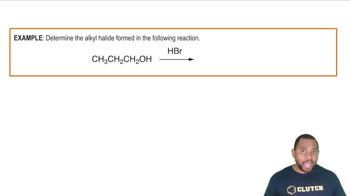
    The alcohol is converted into an alkyl bromide, with the -OH group replaced by a bromine atom.
  • What functional group is present in alcohols before substitution reactions with HCl or HBr?

    Alcohols contain a hydroxyl (-OH) group bonded to a carbon atom.
  • What is the general result of a substitution reaction between an alcohol and a strong acid like HCl or HBr?

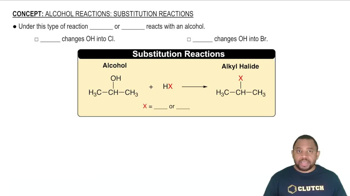
    The alcohol is transformed into an alkyl halide, where the carbon is bonded to a halogen instead of the -OH group.
  • Which halogens are commonly introduced to alcohols during substitution reactions discussed in this lesson?

    Chlorine (Cl) and bromine (Br) are commonly introduced via HCl and HBr, respectively.
  • What does 'X' represent in the example reaction shown in the lesson?

    X represents either Cl or Br, depending on whether HCl or HBr is used in the reaction.
  • How does the chemical property of a molecule change when an alcohol is converted to an alkyl halide?

    The molecule becomes more reactive and its properties change due to the replacement of the polar -OH group with a halogen.
  • What is the starting material in the substitution reactions described in the lesson?

    The starting material is an alcohol, which contains a hydroxyl group.
  • What is the role of hydrochloric acid in the substitution reaction with alcohols?

    Hydrochloric acid provides the chlorine atom that replaces the hydroxyl group in the alcohol.
  • What is the role of hydrobromic acid in the substitution reaction with alcohols?

    Hydrobromic acid provides the bromine atom that replaces the hydroxyl group in the alcohol.
  • After substitution with HCl or HBr, what is the new group attached to the carbon formerly bonded to -OH?

    The carbon is now bonded to a halogen atom, either chlorine or bromine.
  • What type of reaction is described when alcohols are converted to alkyl halides using HCl or HBr?

    This is a substitution reaction, where the -OH group is replaced by a halogen.
  • Why is the conversion of alcohols to alkyl halides important in organic chemistry?

    It allows for modification of functional groups, leading to changes in chemical properties and reactivity.
  • What happens to the carbon atom in an alcohol during a substitution reaction with HCl or HBr?

    The carbon atom loses its bond to the -OH group and forms a new bond with a halogen atom.
  • What is the simplest way to convert an alcohol to an alkyl halide according to the lesson?

    React the alcohol with HCl to get an alkyl chloride or with HBr to get an alkyl bromide.