Back

Alcohol Reactions: Dehydration Reactions quiz

Control buttons has been changed to "navigation" mode.
1/15
  • What reagent is commonly used to dehydrate alcohols to form alkenes?

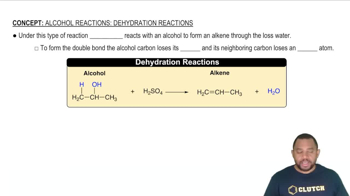
    Sulfuric acid (H2SO4) is commonly used to dehydrate alcohols to form alkenes.
  • What is lost from the alcohol molecule during a dehydration reaction?

    A water molecule (H2O) is lost during a dehydration reaction.
  • Which group is lost from the alcohol carbon in a dehydration reaction?

    The hydroxyl group (OH) is lost from the alcohol carbon.
  • From which neighboring carbon is the hydrogen atom removed during dehydration?

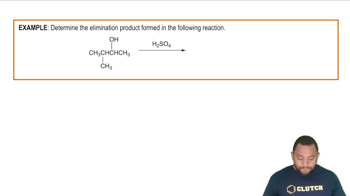
    The hydrogen atom is removed from the neighboring carbon with fewer hydrogens, according to Zaitsev's rule.
  • What type of bond is formed between the two carbons after dehydration?

    A double bond is formed between the two carbons, resulting in an alkene.
  • What rule helps predict the major alkene product in alcohol dehydration?

    Zaitsev's rule helps predict the major alkene product.
  • Why do the two carbons involved in dehydration form a double bond?

    They form a double bond to maintain four bonds each after losing an OH and an H.
  • What happens if the neighboring carbons to the alcohol carbon are identical?

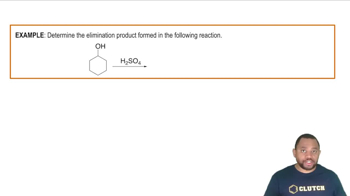
    The hydrogen can be removed from either side, leading to the same alkene product.
  • What is the main product of an alcohol dehydration reaction?

    The main product is an alkene.
  • What must be true about the number of hydrogens on neighboring carbons for Zaitsev's rule to apply?

    The neighboring carbons must have different numbers of hydrogens.
  • What is the role of sulfuric acid in the dehydration reaction?

    Sulfuric acid acts as a catalyst to promote the loss of water from the alcohol.
  • What is the fate of the OH group during the dehydration of an alcohol?

    The OH group is removed from the alcohol carbon as part of the water molecule.
  • How does Zaitsev's rule affect the stability of the alkene product?

    Zaitsev's rule favors the formation of the more stable, more substituted alkene.
  • What is the general mechanism for forming an alkene from an alcohol?

    The alcohol loses an OH group, a neighboring carbon loses an H, and a double bond forms between them.
  • Why is understanding the dehydration mechanism important in organic synthesis?

    It is crucial for predicting reaction outcomes and synthesizing specific alkenes from alcohols.