Back

First Law of Thermodynamics quiz

Control buttons has been changed to "navigation" mode.
1/15
  • What does the First Law of Thermodynamics state about energy?

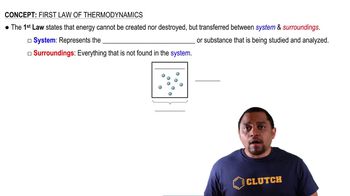
    It states that energy cannot be created or destroyed, only transferred between a system and its surroundings.
  • In chemistry, what is typically considered the 'system'?

    The system is the chemical reaction or substance being studied or analyzed.
  • What are the 'surroundings' in the context of thermodynamics?

    The surroundings are everything outside the system, including the container and the rest of the universe.
  • How is energy transferred between a system and its surroundings?

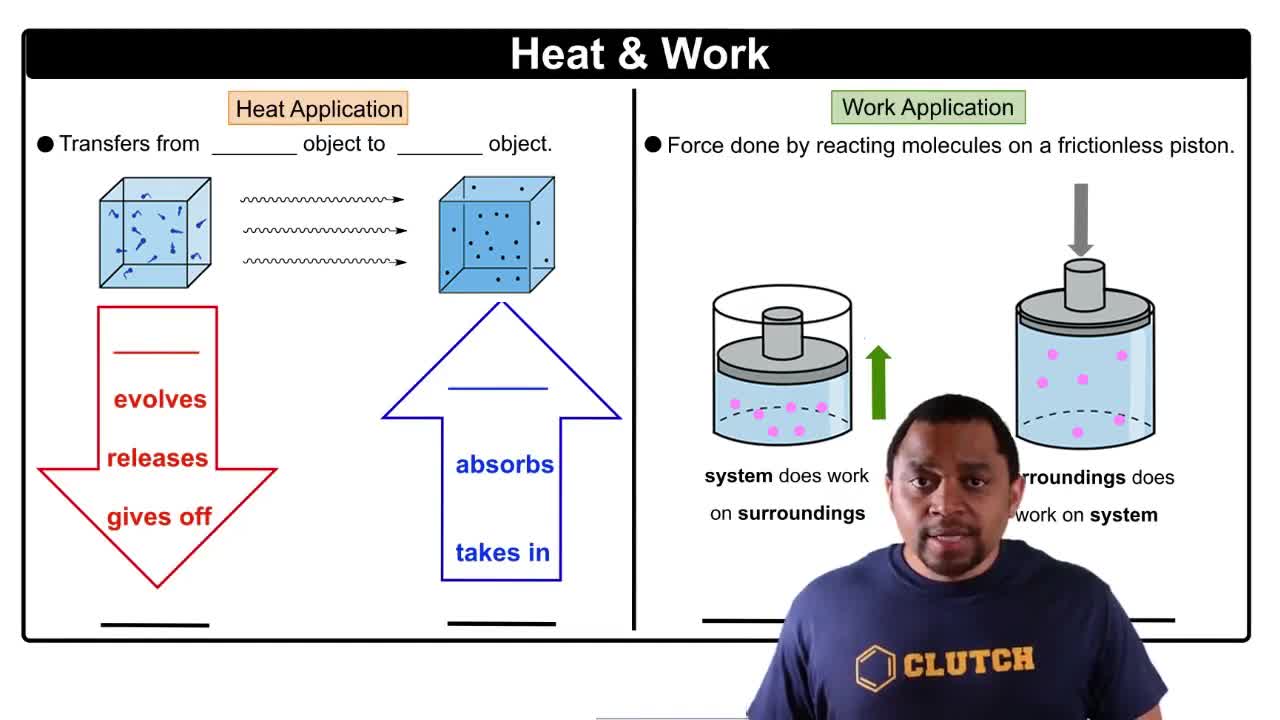
    Energy is transferred as either heat (q) or work (w).
  • What does the variable 'q' represent in thermodynamics?

    'q' represents heat, which is the flow of thermal energy from a higher temperature object to a lower temperature object.
  • What does the variable 'w' represent in thermodynamics?

    'w' represents work, which is the movement of reacting molecules against gravity or an opposing force.
  • When is the sign of q positive for a system?

    The sign of q is positive when the system gains, absorbs, or takes in heat.
  • When is the sign of q negative for a system?

    The sign of q is negative when the system loses, evolves, releases, or gives off heat.
  • In which direction does heat naturally flow?

    Heat naturally flows from a hotter object to a colder object.
  • When is the sign of w negative for a system?

    The sign of w is negative when the system does work on the surroundings.
  • When is the sign of w positive for a system?

    The sign of w is positive when the surroundings do work on the system.
  • What happens to the sign of q if a system absorbs heat?

    If a system absorbs heat, q is positive.
  • What happens to the sign of q if a system releases heat?

    If a system releases heat, q is negative.
  • What is an example of the system doing work on the surroundings?

    If gas molecules push up against a piston, the system is doing work on the surroundings, making w negative.
  • What is an example of the surroundings doing work on the system?

    If a piston is pushed down by an outside force, the surroundings are doing work on the system, making w positive.