
Ozone, O3(g), is a form of elemental oxygen that plays an important role in the absorption of ultraviolet radiation in the stratosphere. It decomposes to O2(g) at room temperature and pressure according to the following reaction: 2 O3(g) → 3 O2(g) ΔH= -284.6 kJ b. Which has the higher enthalpy under these conditions, 2 O3(g) or 3 O2(g)?
Ch.5 - Thermochemistry

Brown15th EditionChemistry: The Central ScienceISBN: 9780137542970Not the one you use?Change textbook
Chapter 5, Problem 42a
Without referring to tables, predict which of the following has the higher enthalpy in each case: (a) 1 mol CO2(s) or 1 mol CO2(g) at the same temperature
Verified step by step guidance1
Identify the states of matter for CO2: solid (s) and gas (g).
Recall that enthalpy is a measure of the total energy of a thermodynamic system, including internal energy and energy required to make room for it by displacing its environment.
Understand that gases generally have higher enthalpy than solids at the same temperature because they have higher kinetic energy and require more energy to maintain their state.
Consider the energy required for phase changes: transitioning from solid to gas (sublimation) requires energy input, indicating that the gaseous state has higher enthalpy.
Conclude that 1 mol CO2(g) has higher enthalpy than 1 mol CO2(s) at the same temperature.

Verified video answer for a similar problem:
This video solution was recommended by our tutors as helpful for the problem above.
Video duration:
1mWas this helpful?
Key Concepts
Here are the essential concepts you must grasp in order to answer the question correctly.
Enthalpy
Enthalpy is a thermodynamic property that represents the total heat content of a system. It is defined as the sum of the internal energy and the product of pressure and volume. Enthalpy changes are crucial for understanding heat transfer during chemical reactions and phase changes, making it essential for predicting the stability and energy of substances in different states.
Recommended video:
Guided course
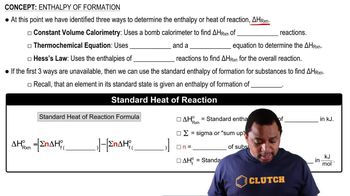
Enthalpy of Formation
Phase Changes
Phase changes refer to the transitions between solid, liquid, and gas states of matter. These changes involve energy transfer, typically in the form of heat, which affects the enthalpy of the substances. For example, when a solid transitions to a gas (sublimation), it absorbs energy, resulting in a higher enthalpy for the gaseous state compared to the solid state at the same temperature.
Recommended video:
Guided course
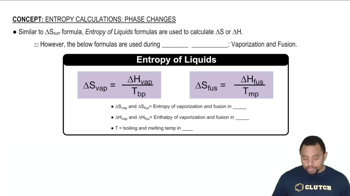
Entropy in Phase Changes
Gibbs Free Energy
Gibbs Free Energy (G) is a thermodynamic potential that measures the maximum reversible work obtainable from a thermodynamic system at constant temperature and pressure. It combines enthalpy and entropy to predict the spontaneity of processes. While not directly asked in the question, understanding Gibbs Free Energy helps contextualize why gases generally have higher enthalpy than solids, as they possess greater disorder and energy.
Recommended video:
Guided course
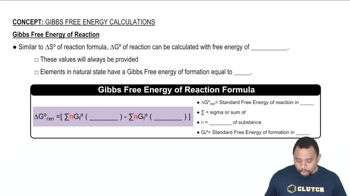
Gibbs Free Energy of Reactions
Related Practice
Textbook Question
Textbook Question
The decomposition of Ca(OH)2 into CaO(s) and H2O at constant pressure requires the addition of 109 kJ of heat per mole of Ca(OH)2 . b. Draw an enthalpy diagram for the reaction.
Textbook Question
Without referring to tables, predict which of the following has the higher enthalpy in each case: (c) 1 mol H2(g) and 0.5 mol O2(g) at 25 °C or 1 mol H2O(g) at 25 °C
Textbook Question
Without referring to tables, predict which of the following has the higher enthalpy in each case: (b) 2 mol of hydrogen atoms or 1 mol of H2
Textbook Question
The complete combustion of ethanol, C2H5OH(l), to form H2O(g) and CO2(g) at constant pressure releases 1235 kJ of heat per mole of C2H5OH. b. Draw an enthalpy diagram for the reaction.
