(c) Hydrogen peroxide is sold commercially as an aqueous solution in brown bottles to protect it from light. Calculate the longest wavelength of light that has sufficient energy to break the weakest bond in hydrogen peroxide.
Ch.8 - Basic Concepts of Chemical Bonding
Brown14th EditionChemistry: The Central ScienceISBN: 9780134414232Not the one you use?Change textbook
Chapter 8, Problem 100
The electron affinity of oxygen is -141 kJ/mol, corresponding to the reaction O(g) + e- → O-(g). The lattice energy of K2O(s) is 2238 kJ/mol. Use these data along with data in Appendix C and Figure 7.10 to calculate the 'second electron affinity' of oxygen, corresponding to the reaction O-(g) + e- → O2-(g)
Verified step by step guidance1
Identify the Born-Haber cycle for the formation of K2O(s) from its elements in their standard states.
Write the equation for the formation of K2O(s) from K(s) and O2(g), and break it down into individual steps, including sublimation, ionization, bond dissociation, and electron affinity.
Use Hess's Law to relate the lattice energy, the first electron affinity, and the unknown second electron affinity to the enthalpy change of the overall reaction.
Set up the equation using the given lattice energy, the first electron affinity, and other necessary thermodynamic data from Appendix C and Figure 7.10.
Solve for the second electron affinity of oxygen by rearranging the equation and substituting the known values.

Verified video answer for a similar problem:
This video solution was recommended by our tutors as helpful for the problem above.
Video duration:
7mWas this helpful?
Key Concepts
Here are the essential concepts you must grasp in order to answer the question correctly.
Electron Affinity
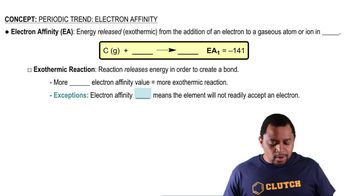
Electron affinity is the energy change that occurs when an electron is added to a neutral atom in the gas phase, forming a negatively charged ion. A negative value indicates that energy is released during this process, making it favorable. For oxygen, the first electron affinity is -141 kJ/mol, meaning energy is released when an electron is added to form O<sup>-</sup>.
Recommended video:
Guided course
Electron Affinity
Lattice Energy
Lattice energy is the amount of energy released when gaseous ions combine to form an ionic solid. It is a measure of the strength of the forces between the ions in an ionic compound. In the case of K<sub>2</sub>O, the lattice energy of 2238 kJ/mol indicates a strong attraction between K<sup>+</sup> and O<sup>2-</sup> ions, which is crucial for understanding the stability of the ionic compound.
Recommended video:
Guided course
Lattice Energy
Second Electron Affinity
The second electron affinity refers to the energy change associated with adding a second electron to a negatively charged ion, forming a doubly charged anion. This process is generally endothermic, meaning it requires energy input, as the negatively charged ion repels the incoming electron. For oxygen, calculating the second electron affinity involves considering the energy required to overcome this repulsion, which can be derived from the first electron affinity and lattice energy.
Recommended video:
Guided course
Electron Affinity
Related Practice
Textbook Question
Textbook Question
Consider the molecule C4H5N, which has the connectivity shown below. (a) After the Lewis structure for the molecule is completed, how many s and how many p bonds are there in this molecule?
Textbook Question
The Ti2+ ion is isoelectronic with the Ca atom. (c) What charge would Ti have to be isoelectronic with Ca2+ ?
Textbook Question
One scale for electronegativity is based on the concept that the electronegativity of any atom is proportional to the ionization energy of the atom minus its electron affinity: electronegativity = k1I - EA2, where k is a proportionality constant. (b) Why are both ionization energy and electron affinity relevant to the notion of electronegativity?