Explain why the properties of boron differ so markedly from the properties of the other group 3A elements.
Ch.22 - The Main Group Elements
Chapter 22, Problem 22.60
Compare some of the physical properties of H2S, NaH, and PdHx.
Verified step by step guidance1
Step 1: Start by identifying the type of bonding in each compound. H2S is a covalent compound, NaH is an ionic compound, and PdHx is a metallic compound.
Step 2: Consider the physical properties that are typically associated with each type of bonding. Covalent compounds like H2S usually have low melting and boiling points, are poor conductors of electricity, and are often gases or liquids at room temperature. Ionic compounds like NaH usually have high melting and boiling points, are good conductors of electricity when dissolved in water or melted, and are often solids at room temperature. Metallic compounds like PdHx usually have variable melting and boiling points, are good conductors of electricity and heat, and are often solids at room temperature.
Step 3: Consider the specific properties of each compound. For example, H2S is a gas at room temperature with a strong, unpleasant smell. NaH is a solid at room temperature that reacts violently with water. PdHx is a solid at room temperature that can absorb a large amount of hydrogen gas.
Step 4: Consider the effect of molecular structure on the properties of the compounds. For example, the bent shape of the H2S molecule due to its two lone pairs of electrons can affect its properties.
Step 5: Finally, compare the properties of the three compounds. For example, H2S and NaH are both poor conductors of electricity, but NaH has a much higher melting point. PdHx and NaH are both solids at room temperature, but PdHx is a much better conductor of electricity.

Verified video answer for a similar problem:
This video solution was recommended by our tutors as helpful for the problem above.
Was this helpful?
Key Concepts
Here are the essential concepts you must grasp in order to answer the question correctly.
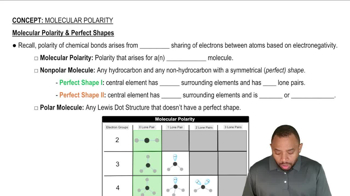
Molecular Structure and Polarity
The molecular structure of a compound determines its polarity, which affects its physical properties such as boiling point, solubility, and intermolecular interactions. For instance, H2S is a polar molecule due to its bent shape and the electronegativity difference between hydrogen and sulfur, leading to stronger dipole-dipole interactions compared to nonpolar molecules.
Recommended video:
Guided course
Molecular Polarity
Ionic vs. Covalent Compounds
Understanding the difference between ionic and covalent compounds is crucial for comparing physical properties. NaH is an ionic compound, which typically has high melting and boiling points due to strong electrostatic forces between ions, while H2S and PdHx are covalent, exhibiting lower melting and boiling points due to weaker van der Waals forces.
Recommended video:
Guided course
Ionic Compounds Naming
Metal-Hydride Properties
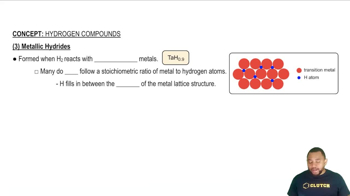
Metal hydrides, such as PdHx, exhibit unique properties due to the interaction between metal and hydrogen. These compounds can have varying stoichiometries and can influence the physical properties like density and thermal conductivity, which differ significantly from those of molecular compounds like H2S and ionic compounds like NaH.
Recommended video:
Guided course
Metallic Hydrides
Related Practice
Textbook Question
2
views
Textbook Question
GeCl4 reacts with Cl- to give GeCl62-, but CCl4 does not react with excess Cl-. Explain.
Textbook Question
In what forms is oxygen commonly found in nature?
Textbook Question
Describe the structures of the white and red allotropes of phosphorus, and explain why white phosphorus is so reactive.
Textbook Question
Using the shorthand notation of Figure 22.9, draw the structure of the cyclic silicate anion in which four SiO4 tetrahedra share O atoms to form an eight-membered ring of alternating Si and O atoms. Give the formula and charge of the anion.
Textbook Question
Which of the group 4A elements have allotropes with the diamond structure? Which have metallic allotropes? How does the variation in the structure of the group 4A elements illustrate how metallic character varies down a periodic group?