Each of the following elements is capable of forming an ion in chemical reactions. By referring to the periodic table, predict the charge of the most stable ion of each: c. K

Ch.2 - Atoms, Molecules, and Ions

Brown15th EditionChemistry: The Central ScienceISBN: 9780137542970Not the one you use?Change textbook
Chapter 2, Problem 58e
Using the periodic table, predict the charge of the most stable ion of the following elements: e. Se
Verified step by step guidance1
Identify the group number of the element Selenium (Se) on the periodic table. Selenium is located in Group 16.
Recall that elements in Group 16 typically form ions with a charge of -2. This is because they tend to gain two electrons to achieve a full outer shell, similar to the nearest noble gas configuration.
Understand that the most stable ion of an element is often the one that achieves a noble gas electron configuration. For Selenium, gaining two electrons will result in the electron configuration of Krypton, a noble gas.
Conclude that the most stable ion of Selenium (Se) is Se²⁻, as it achieves a stable electron configuration by gaining two electrons.
Verify your prediction by considering the general trend: elements in Group 16, such as Oxygen and Sulfur, also form ions with a -2 charge, supporting the prediction for Selenium.

Verified video answer for a similar problem:
This video solution was recommended by our tutors as helpful for the problem above.
Video duration:
1mWas this helpful?
Key Concepts
Here are the essential concepts you must grasp in order to answer the question correctly.
Periodic Table and Group Trends
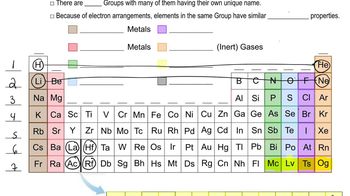
The periodic table organizes elements based on their atomic number and electron configuration, revealing trends in properties such as electronegativity and ionization energy. Elements in the same group (column) typically exhibit similar chemical behavior, including the charge of their most stable ions. For example, elements in Group 16, like selenium (Se), tend to gain electrons to achieve a stable octet, leading to a common charge of -2.
Recommended video:
Guided course
Periodic Table: Group Names
Ion Formation and Stability
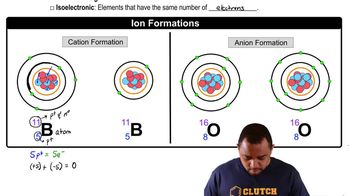
Ions are formed when atoms gain or lose electrons to achieve a more stable electronic configuration, often resembling that of the nearest noble gas. The stability of an ion is influenced by its charge and the energy required to form it. For selenium, gaining two electrons to form a Se²⁻ ion is energetically favorable, as it completes its valence shell, making it the most stable ion.
Recommended video:
Guided course
Ion Formation
Electronegativity and Electron Affinity
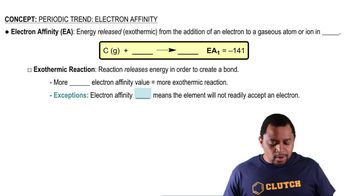
Electronegativity is a measure of an atom's ability to attract and hold onto electrons, while electron affinity refers to the energy change when an electron is added to a neutral atom. Elements with high electronegativity, like selenium, have a strong tendency to gain electrons, which contributes to the formation of negatively charged ions. This property is crucial for predicting the charge of ions formed by elements in chemical reactions.
Recommended video:
Guided course
Electron Affinity
Related Practice
Textbook Question
Textbook Question
Using the periodic table to guide you, predict the chemical formula and name of the compound formed by the following elements: (d) K and S.
Textbook Question
Using the periodic table, predict the charge of the most stable ion of the following elements: d. Br
Textbook Question
Fill in the gaps in the following table:
Symbol 31P3-
Protons 34 50
Neutrons 45 69 118
Electrons 46 76
Net charge 2- 3+
Textbook Question
Using the periodic table to guide you, predict the chemical formula and name of the compound formed by the following elements: (c) Al and I
Textbook Question
Using the periodic table to guide you, predict the chemical formula and name of the compound formed by the following elements: (a) Ga and F (b) Li and H