Join thousands of students who trust us to help them ace their exams!
Multiple Choice
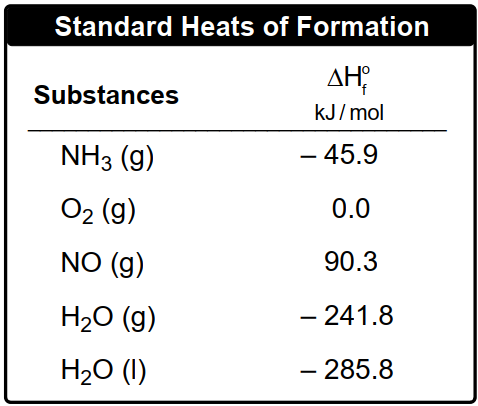
The oxidation of ammonia is illustrated by the following equation: 4 NH3 (g) + 5 O2 (g) → 4 NO (g) + 6 H2O (g) Calculate the enthalpy of reaction, ΔHRxn, based on the given standard heats of formation.
A
-906 kJ
B
-1273.2 kJ
C
1089.6 kJ
D
-183.6 kJ
0 Comments
Verified step by step guidance
1
Write down the balanced chemical equation: \(4 \mathrm{NH_3 (g)} + 5 \mathrm{O_2 (g)} \rightarrow 4 \mathrm{NO (g)} + 6 \mathrm{H_2O (g)}\).
Recall the formula to calculate the enthalpy change of the reaction using standard heats of formation: \(\Delta H_{\mathrm{Rxn}} = \sum \Delta H_f^\circ (\text{products}) - \sum \Delta H_f^\circ (\text{reactants})\).
Calculate the total enthalpy of formation for the products by multiplying the standard heat of formation of each product by its coefficient and summing: \(4 \times \Delta H_f^\circ (\mathrm{NO (g)}) + 6 \times \Delta H_f^\circ (\mathrm{H_2O (g)})\).
Calculate the total enthalpy of formation for the reactants similarly: \(4 \times \Delta H_f^\circ (\mathrm{NH_3 (g)}) + 5 \times \Delta H_f^\circ (\mathrm{O_2 (g)})\).
Subtract the total enthalpy of the reactants from that of the products to find \(\Delta H_{\mathrm{Rxn}}\): \(\Delta H_{\mathrm{Rxn}} = [4 \times 90.3 + 6 \times (-241.8)] - [4 \times (-45.9) + 5 \times 0]\).


 Verified step by step guidance