
As discussed in the A Closer Look box on 'Measurement and the Uncertainty Principle,' the essence of the uncertainty principle is that we can't make a measurement without disturbing the system that we are measuring. (a) Why can't we measure the position of a subatomic particle without disturbing it?

Determine whether each of the following sets of quantum numbers for the hydrogen atom is valid. If a set is not valid, then indicate which of the quantum numbers has a value that is not valid: e. n = 2, l = 2, ml = 1, ms = +1/2
Verified step by step guidance
Verified video answer for a similar problem:
Key Concepts
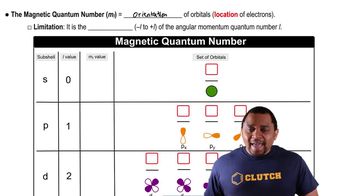
Quantum Numbers
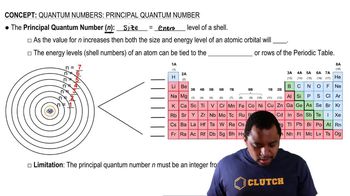
Principal Quantum Number (n)
Azimuthal Quantum Number (l)
The series of emission lines of the hydrogen atom for which nf = 3 is called the Paschen series. (b) Calculate the wavelengths of the first three lines in the Paschen series—those for which ni = 4, 5, and 6.
The human retina has three types of receptor cones, each sensitive to a different range of wavelengths of visible light, as shown in this figure (the colors are merely to differentiate the three curves from one another; they do not indicate the actual colors represented by each curve):
(c) Explain why the sky appears blue even though all wavelengths of solar light are scattered by the atmosphere.
The series of emission lines of the hydrogen atom for which nf = 3 is called the Paschen series. (a) Determine the region of the electromagnetic spectrum in which the lines of the Paschen series are observed.
The Chemistry and Life box in Section 6.7 described the techniques called NMR and MRI. (c) When the 450-MHz photon is absorbed, does it change the spin of the electron or the proton on a hydrogen atom?
