Explain why the properties of boron differ so markedly from the properties of the other group 3A elements.
Ch.22 - The Main Group Elements
Chapter 22, Problem 22.119
In what forms is oxygen commonly found in nature?
Verified step by step guidance1
Oxygen is most commonly found in nature in the form of diatomic molecules, represented as \( O_2 \). This is the form of oxygen that makes up about 21% of Earth's atmosphere.
Another common form of oxygen in nature is ozone, represented as \( O_3 \). Ozone is found in the Earth's stratosphere and plays a crucial role in absorbing ultraviolet radiation from the sun.
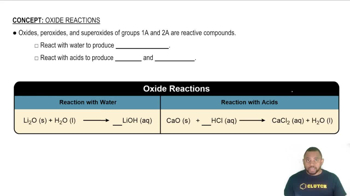
Oxygen is also found in combined forms in various compounds. For example, it is a major component of water (\( H_2O \)) and is present in many minerals and rocks as oxides, such as silicon dioxide (\( SiO_2 \)).
In biological systems, oxygen is found in organic compounds, such as carbohydrates, proteins, and fats, where it is bonded to carbon and hydrogen atoms.
Oxygen is also present in the form of ions, such as the oxide ion (\( O^{2-} \)), in ionic compounds like metal oxides.

Verified video answer for a similar problem:
This video solution was recommended by our tutors as helpful for the problem above.
Was this helpful?
Key Concepts
Here are the essential concepts you must grasp in order to answer the question correctly.
Molecular Oxygen (O2)
Molecular oxygen, or O2, is the most abundant form of oxygen in the Earth's atmosphere, making up about 21% of it. It is essential for the respiration of most living organisms and is produced during photosynthesis by plants. O2 exists as a diatomic molecule, meaning two oxygen atoms are bonded together.
Recommended video:
Guided course
Determining Molecular Formulas
Ozone (O3)
Ozone, or O3, is another significant form of oxygen found in nature, primarily in the Earth's stratosphere. It forms a protective layer that absorbs the majority of the sun's harmful ultraviolet radiation. While beneficial in the stratosphere, ground-level ozone can be a harmful pollutant affecting air quality and human health.
Recommended video:
Guided course
Nitrogen Family Reactions Example
Oxides
Oxides are compounds formed when oxygen reacts with other elements, resulting in a wide variety of substances such as carbon dioxide (CO2) and iron oxide (rust). These compounds are prevalent in nature and play crucial roles in processes like combustion, respiration, and mineral formation. They are essential for understanding the chemical interactions in ecosystems.
Recommended video:
Guided course
Oxide Reactions
Related Practice
Textbook Question
2
views
Textbook Question
Which of the following oxides will be more soluble in acidic solution? (LO 22.14)
(a) SiO2 (b) NO2
(c) BaO (d) B2O3
Textbook Question
Describe the structures of the white and red allotropes of phosphorus, and explain why white phosphorus is so reactive.
Textbook Question
Compare some of the physical properties of H2S, NaH, and PdHx.
Textbook Question
The following models represent the structures of binary hydrides
of second-row elements:
(a) Identify the nonhydrogen atom in each case, and write the molecular formula for each hydride.
Textbook Question
Look at the location of elements A, B, C, and D in the following
periodic table:
(c) Which hydrides react with water to give H2 gas? Write a balanced net ionic equation for each reaction.