A solid white substance A is heated strongly in the absence of air. It decomposes to form a new white substance B and a gas C. The gas has exactly the same properties as the product obtained when carbon is burned in an excess of oxygen. Based on these observations, can we determine whether solids A and B and gas C are elements or compounds?
Ch.1 - Introduction: Matter, Energy, and Measurement
Brown14th EditionChemistry: The Central ScienceISBN: 9780134414232Not the one you use?Change textbook
All textbooks
Brown 14th Edition
Ch.1 - Introduction: Matter, Energy, and Measurement
Problem 15f,g,h,i,j
Brown 14th Edition
Ch.1 - Introduction: Matter, Energy, and Measurement
Problem 15f,g,h,i,jChapter 1, Problem 15f,g,h,i,j
Give the chemical symbol or name for the following elements, as appropriate: (f) Sb (g) Pb (h) Br (i) V (j) Hg.
Verified step by step guidance1
Step 1: Identify the chemical symbol 'Sb'. The element with the symbol 'Sb' is Antimony.
Step 2: Identify the chemical symbol 'Pb'. The element with the symbol 'Pb' is Lead.
Step 3: Identify the chemical symbol 'Br'. The element with the symbol 'Br' is Bromine.
Step 4: Identify the chemical symbol 'V'. The element with the symbol 'V' is Vanadium.
Step 5: Identify the chemical symbol 'Hg'. The element with the symbol 'Hg' is Mercury.

Verified video answer for a similar problem:
This video solution was recommended by our tutors as helpful for the problem above.
Video duration:
53sWas this helpful?
Key Concepts
Here are the essential concepts you must grasp in order to answer the question correctly.
Chemical Symbols
Chemical symbols are one- or two-letter notations used to represent chemical elements. The first letter is always capitalized, while the second, if present, is lowercase. For example, 'H' represents hydrogen, and 'O' represents oxygen. Understanding these symbols is essential for identifying elements in chemical formulas and equations.
Recommended video:
Guided course
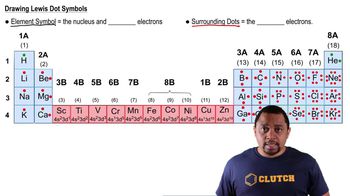
Lewis Dot Symbols
Periodic Table of Elements
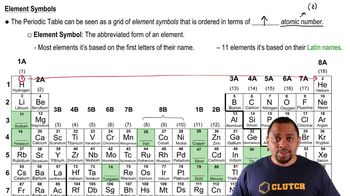
The periodic table organizes all known chemical elements based on their atomic number, electron configuration, and recurring chemical properties. Elements are grouped into rows (periods) and columns (groups) that reflect their similarities. Familiarity with the periodic table helps in recognizing elements by their symbols and understanding their relationships.
Recommended video:
Guided course
Periodic Table History
Element Names
Each chemical element has a unique name that corresponds to its chemical symbol. These names often derive from Latin, Greek, or the names of scientists. For instance, 'Sb' stands for antimony, 'Pb' for lead, and 'Hg' for mercury. Knowing the names of elements is crucial for effective communication in chemistry and for understanding their applications.
Recommended video:
Guided course
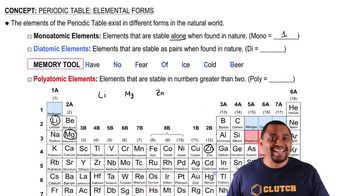
Elemental Forms of Elements
Related Practice
Textbook Question
117
views
Textbook Question
Classify each of the following as a pure substance or a mixture. If a mixture, indicate whether it is homogeneous or heterogeneous: (d) mayonnaise.
84
views
Textbook Question
Give the chemical symbol or name for each of the following elements, as appropriate: (a) rhenium (b) tungsten (c) cesium (d) hydrogen (e) indium
1
views
Textbook Question
Give the chemical symbol or name for each of the following elements, as appropriate: (f) As (g) Xe (h) Kr (i) Te (j) Ge.
Textbook Question
Give the chemical symbol or name for the following elements, as appropriate: (a) helium (b) platinum (c) cobalt (d) tin (e) silver
1
views
Textbook Question
Classify each of the following as a pure substance or a mixture. If a mixture, indicate whether it is homogeneous or heterogeneous: (c) diamond
69
views
1
rank