
Textbook Question
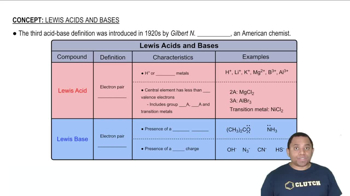
The fluoride ion reacts with water to produce HF. (c) Is fluoride acting as a Lewis acid or as a Lewis base when reacting with water?

 Verified step by step guidance
 05:04
05:04
 00:47
00:47 02:31
02:31Indicate whether each of the following statements is true or false. For each statement that is false, correct the statement to make it true. (a) Acid strength in a series of H¬A molecules increases with increasing size of A. (b) For acids of the same general structure but differing electronegativities of the central atoms, acid strength decreases with increasing electronegativity of the central atom. (c) The strongest acid known is HF because fluorine is the most electronegative element.
Identify the Lewis acid and Lewis base in each of the following reactions:
(a) HNO2(aq) + OH-(aq) ⇌ NO2-(aq) + H2O(l)
(b) FeBr3(s) + Br-(aq) ⇌ FeBr4-(aq)
(c) Zn2+(aq) + 4 NH3(aq) ⇌ Zn(NH3)42+(aq)
(d) SO2(g) + H2O(l) ⇌ H2SO3(aq)
Which member of each pair produces the more acidic aqueous solution: (a) ZnBr2 or CdCl2 (b) CuCl or Cu(NO3)2 (c) Ca(NO3)2 or NiBr2