
The O—H bond lengths in the water molecule (H2O) are 0.96 Å, and the H—O—H angle is 104.5°. The overall dipole moment of the water molecule is 1.85 D. b. Calculate the magnitude of the bond dipole of the O─H bonds. (Note: You will need to use vector addition to do this.)
Ch.9 - Molecular Geometry and Bonding Theories

Brown15th EditionChemistry: The Central ScienceISBN: 9780137542970Not the one you use?Change textbook
Chapter 9, Problem 92c
An AB5 molecule adopts the geometry shown here.
c. Suppose the B atoms are halogen atoms. Of which group in the periodic table is atom A a member:
i. group 5A
ii. group 6A
iii. group 7A
iv. group 8A, or
v. is more information needed?
Verified step by step guidance1
Identify the molecular geometry of an AB5 molecule. AB5 molecules typically adopt a trigonal bipyramidal structure.
Understand the electron pair geometry around the central atom, A, in the AB5 molecule. The central atom A is surrounded by five bonding pairs and no lone pairs.
Recognize that the B atoms are halogens, which belong to group 7A in the periodic table. Each halogen atom contributes one valence electron.
Determine the total number of valence electrons provided by the five B atoms. Since each halogen contributes one electron, and there are five B atoms, the total contribution from B atoms is 5 electrons.
Consider the valence electron requirement for the central atom A to achieve a stable electron configuration. Since the molecule is neutral and stable, and the B atoms contribute 5 electrons, atom A must provide enough electrons to complete an octet around itself. This typically means A must have 3 valence electrons initially, suggesting it belongs to group 5A.

Verified video answer for a similar problem:
This video solution was recommended by our tutors as helpful for the problem above.
Video duration:
1mWas this helpful?
Key Concepts
Here are the essential concepts you must grasp in order to answer the question correctly.
Molecular Geometry
Molecular geometry refers to the three-dimensional arrangement of atoms within a molecule. The shape of a molecule is determined by the number of bonding pairs and lone pairs of electrons around the central atom, which influences the angles between bonds. Understanding molecular geometry is crucial for predicting the behavior and reactivity of molecules, especially in the context of VSEPR (Valence Shell Electron Pair Repulsion) theory.
Recommended video:
Guided course
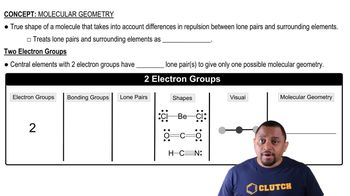
Molecular Geometry with Two Electron Groups
Periodic Table Groups
The periodic table is organized into groups (columns) that share similar chemical properties. Elements in the same group have the same number of valence electrons, which influences their bonding behavior and reactivity. For example, group 5A elements typically form five bonds, while group 6A elements form six, and group 7A elements form seven, which is essential for determining the identity of atom A in the AB5 molecule.
Recommended video:
Guided course
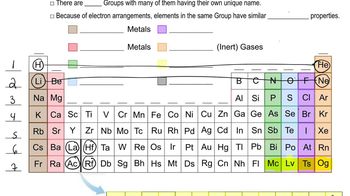
Periodic Table: Group Names
Halogens and Their Bonding
Halogens are elements found in group 7A of the periodic table and are known for their high reactivity due to their seven valence electrons. They typically form one bond to achieve a stable octet configuration. In the context of the AB5 molecule, if the B atoms are halogens, the central atom A must have a bonding capacity that allows it to form five bonds, which can help identify its group in the periodic table.
Recommended video:
Guided course
Halogenation Reactions
Related Practice
Textbook Question
Textbook Question
The lactic acid molecule, CH3CH(OH)COOH, gives sour milk its unpleasant, sour taste. e. What are the approximate bond angles around each carbon atom in the molecule?
Textbook Question
a. Predict the electron-domain geometry around the central Xe atom in XeF2, XeF4, and XeF6.
Textbook Question
Which of the following statements about hybrid orbitals is or are true? a. After an atom undergoes sp hybridization, there is one unhybridized p orbital on the atom, b. Under 𝑠𝑝2 hybridization, the large lobes point to the vertices of an equilateral triangle, and c. The angle between the large lobes of 𝑠𝑝3 hybrids is 109.5°.
Textbook Question
An AB5 molecule adopts the geometry shown here. b. What is the electron-domain geometry for the molecule?
