(a) What isotope is used as the standard in establishing the atomic mass scale?
Ch.2 - Atoms, Molecules, and Ions
Brown14th EditionChemistry: The Central ScienceISBN: 9780134414232Not the one you use?Change textbook
Chapter 2, Problem 34a
(a) What is the mass in u of a carbon-12 atom?
Verified step by step guidance1
Understand that the atomic mass unit (u) is defined based on the carbon-12 isotope. By definition, one carbon-12 atom has a mass of exactly 12 atomic mass units (u).
Recall that the atomic mass unit is a standard unit of mass that quantifies mass on an atomic or molecular scale (1 u is approximately equal to 1.66053906660 x 10^-27 kg).
Recognize that the mass of a carbon-12 atom is used as a reference point for the atomic mass unit, meaning it is exactly 12 u by definition.
Consider that this definition is crucial for understanding atomic masses of other elements, as they are measured relative to the carbon-12 standard.
Conclude that the mass of a carbon-12 atom is exactly 12 u, which is a fundamental concept in chemistry for determining the relative atomic masses of other elements.

Verified video answer for a similar problem:
This video solution was recommended by our tutors as helpful for the problem above.
Video duration:
3mWas this helpful?
Key Concepts
Here are the essential concepts you must grasp in order to answer the question correctly.
Atomic Mass Unit (u)
The atomic mass unit (u) is a standard unit of mass used to express atomic and molecular weights. It is defined as one twelfth of the mass of a carbon-12 atom, which is approximately 1.66 x 10^-27 kg. This unit allows chemists to compare the mass of different atoms and molecules on a relative scale.
Recommended video:
Guided course
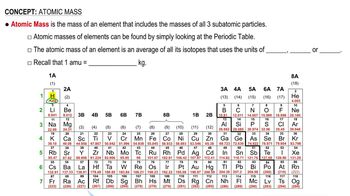
Atomic Mass
Carbon-12 Isotope
Carbon-12 is one of the isotopes of carbon, consisting of 6 protons and 6 neutrons in its nucleus. It is the most abundant carbon isotope, making up about 98.9% of natural carbon. The mass of a carbon-12 atom is defined as exactly 12 u, serving as a reference point for measuring the masses of other isotopes and elements.
Recommended video:
Guided course
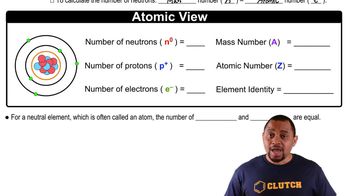
Isotopes
Mass Spectrometry
Mass spectrometry is an analytical technique used to measure the mass-to-charge ratio of ions. It helps in determining the composition of a sample by identifying the masses of its constituent atoms or molecules. Understanding mass spectrometry is essential for interpreting atomic masses and isotopic distributions, which are relevant when discussing the mass of carbon-12.
Recommended video:
Guided course
Atomic Mass
Related Practice
Textbook Question
6
views
Textbook Question
(b) The atomic weight of boron is reported as 10.81, yet no atom of boron has the mass of 10.81 u. Explain.
Textbook Question
Rubidium has two naturally occurring isotopes, rubidium-85 (atomic mass = 84.9118 amu; abundance = 72.15%) and rubidium-87 (atomic mass = 86.9092 amu; abundance = 27.85%). Calculate the atomic weight of rubidium
Textbook Question
Only two isotopes of copper occur naturally: 63Cu (atomic mass = 62.9296 amu; abundance 69.17%) 65Cu (atomic mass = 64.9278 amu; abundance 30.83%). Calculate the atomic weight (average atomic mass) of copper.
4
views
Textbook Question
Without doing any detailed calculations (but using a periodic table to give atomic weights), rank the following samples in order of increasing numbers of atoms: 0.2 mol PCl5 molecules, 80 g Fe2O3, 3.0 3 1023 CO molecules.
1
views
Textbook Question
(b) Why is the atomic weight of carbon reported as 12.011 in the table of elements and the periodic table in the front inside cover of this text?
1
views