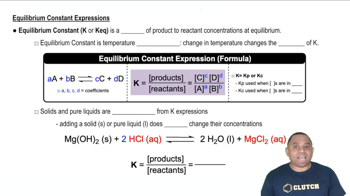
For the reaction shown here, Kc = 255 at 1000 K. CO(g) + Cl2(g) ⇌ COCl2(g) If a reaction mixture initially contains a CO concentration of 0.1500 M and a Cl2 concentration of 0.175 M at 1000 K, what are the equilibrium concentrations of CO, Cl2, and COCl2 at 1000 K?
Consider the reaction and the associated equilibrium constant: aA(g) ⇌ bB(g) Kc = 4.0 Find the equilibrium concentrations of A and B for each value of a and b. Assume that the initial concentration of A in each case is 1.0 M and that no B is present at the beginning of the reaction. c. a=1;b=2
Verified step by step guidance
Verified video answer for a similar problem:
Key Concepts
Equilibrium Constant (Kc)
Initial Concentration and Changes at Equilibrium
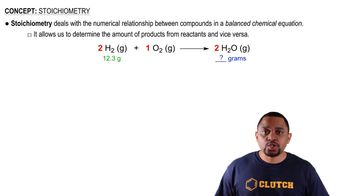
Stoichiometry in Reactions
Consider the reaction: NH4HS(s) ⇌ NH3(g) + H2S(g) At a certain temperature, Kc = 8.5⨉10-3. A reaction mixture at this temperature containing solid NH4HS has [NH3] = 0.166 M and [H2S] = 0.166 M. Will more of the solid form or will some of the existing solid decompose as equilibrium is reached?
For the reaction shown here, Kc = 0.513 at 500 K. N2O4(g) ⇌ 2 NO2(g) If a reaction vessel initially contains an N2O4 concentration of 0.0500 M at 500 K, what are the equilibrium concentrations of N2O4 and NO2 at 500 K?
Silver sulfate dissolves in water according to the reaction: Ag2SO4(s) ⇌ 2 Ag+(aq) + SO42-(aq) Kc = 1.1⨉10-5 at 298 K. A 1.5-L solution contains 6.55 g of dissolved silver sulfate. If additional solid silver sulfate is added to the solution, will it dissolve?
