
Textbook Question
Write the electron configurations for the following ions, and
determine which have noble-gas configurations:
(a) Ti2+
(b) Br-
(c) Mg2+
(d) Po2-
(e) Pt2+
(f) V3+
 Verified step by step guidance
 00:58
00:58
 00:40
00:40 02:52
02:52Order the following transitions in the hydrogen atom from smallest to largest frequency of light absorbed: n = 3 to n = 7, n = 4 to n = 8, n = 2 to n = 5, and n = 1 to n = 3.
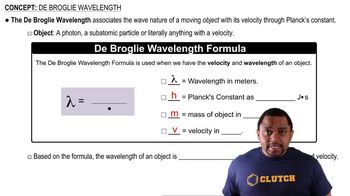
Among the elementary subatomic particles of physics is the muon, which decays within a few microseconds after formation. The muon has a rest mass 206.8 times that of an electron. Calculate the de Broglie wavelength associated with a muon traveling at 8.85 * 105 cm/s.
The hydrogen atom can absorb light of wavelength 1094 nm. (b) Determine the final value of n associated with this absorption.
Use the de Broglie relationship to determine the wavelengths of the following objects: (c) a lithium atom moving at 2.5 × 10⁵ m/s (d) an ozone (O3) molecule in the upper atmosphere moving at 550 m/s.