Consider the following hypothetical aqueous reaction: A(aq) → B(aq). A flask is charged with 0.065 mol of A in a total volume of 100.0 mL. The following data are collected: Time (min) 0 10 20 30 40 Moles of A 0.065 0.051 0.042 0.036 0.031 (b) Calculate the average rate of disappearance of A for each 10-min interval in units of M>s.
Consider the following hypothetical aqueous reaction: A(aq) → B(aq). A flask is charged with 0.065 mol of A in a total volume of 100.0 mL. The following data are collected: Time (min) 0 10 20 30 40 Moles of A 0.065 0.051 0.042 0.036 0.031 (a) Calculate the number of moles of B at each time in the table, assuming that there are no molecules of B at time zero and that A cleanly converts to B with no intermediates.

Verified step by step guidance
Verified video answer for a similar problem:
Key Concepts
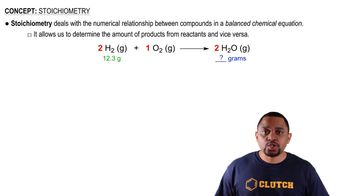
Stoichiometry
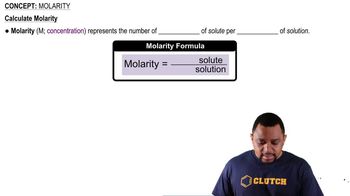
Concentration and Molarity
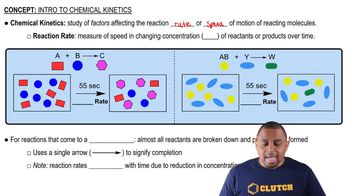
Reaction Kinetics
(c) As a reaction proceeds, does the instantaneous reaction rate increase or decrease?
(b) As the temperature increases, does the reaction rate increase or decrease?
(a) What are the units usually used to express the rates of reactions occurring in solution?
Consider the following hypothetical aqueous reaction: A(aq) → B(aq). A flask is charged with 0.065 mol of A in a total volume of 100.0 mL. The following data are collected: Time (min) 0 10 20 30 40 Moles of A 0.065 0.051 0.042 0.036 0.031 (c) Between t = 10 min and t = 30 min, what is the average rate of appearance of B in units of M/s? Assume that the volume of the solution is constant.
A flask is charged with 0.100 mol of A and allowed to react to form B according to the hypothetical gas-phase reaction A1g2¡B1g2. The following data are collected: Time (s) 0 40 80 120 160 Moles of A 0.100 0.067 0.045 0.030 0.020 (c) Which of the following would be needed to calculate the rate in units of concentration per time: (i) the pressure of the gas at each time, (ii) the volume of the reaction flask, (iii) the temperature, or (iv) the molecular weight of A?
