Some reactions are so rapid that they are said to be diffusion-controlled; that is, the reactants react as quickly as they can collide. An example is the neutralization of H3O+ by OH-, which has a second-order rate constant of 1.3⨉1011 M-1 s-1 at 25 °C. (a) If equal volumes of 2.0 M HCl and 2.0 M NaOH are mixed instantaneously, how much time is required for 99.999% of the acid to be neutralized?
The half-life for the first-order decomposition of N2O4 is 1.3 * 10-5 s. N2O41g2S 2 NO21g2 If N2O4 is introduced into an evacuated flask at a pressure of 17.0 mm Hg, how many seconds are required for the pressure of NO2 to reach 1.3 mm Hg?
Verified step by step guidance
Verified video answer for a similar problem:
Key Concepts
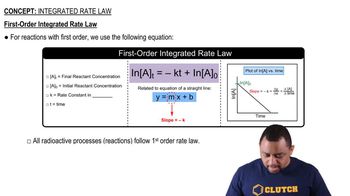
First-Order Kinetics
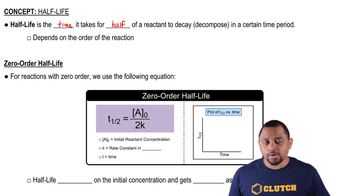
Half-Life
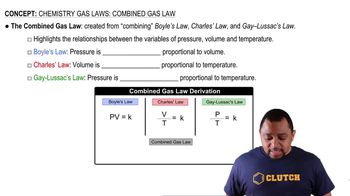
Pressure and Gas Laws
Consider the reversible, first-order interconversion of two molecules A and B: where kf = 3.0⨉10-3 s-1 is the rate constant for the forward reaction and kr = 1.0⨉10-3 s-1 is the rate constant for the reverse reaction. We'll see in Chapter 15 that a reaction does not go to completion but instead reaches a state of equilibrium with comparable concentrations of reactants and products if the rate constants kf and kr have comparable values.
(c) What are the relative concentrations of B and A when the rates of the forward and reverse reactions become equal?
Some reactions are so rapid that they are said to be diffusion-controlled; that is, the reactants react as quickly as they can collide. An example is the neutralization of H3O+ by OH-, which has a second-order rate constant of 1.3⨉1011 M-1 s-1 at 25 °C. (b) Under normal laboratory conditions, would you expect the rate of the acid–base neutralization to be limited by the rate of the reaction or by the speed of mixing?
Consider the reversible, first-order interconversion of two molecules A and B: where kf = 3.0⨉10-3 s-1 is the rate constant for the forward reaction and kr = 1.0⨉10-3 s-1 is the rate constant for the reverse reaction. We'll see in Chapter 15 that a reaction does not go to completion but instead reaches a state of equilibrium with comparable concentrations of reactants and products if the rate constants kf and kr have comparable values.
(b) Draw a qualitative graph that shows how the rates of the forward and reverse reactions vary with time.
