The partial Lewis structure that follows is for a hydrocarbon molecule. In the full Lewis structure, each carbon atom satisfies the octet rule, and there are no unshared electron pairs in the molecule. The carbon—carbon bonds are labeled 1, 2, and 3. (c) Which carbon—carbon bond is the strongest one?
Ch.8 - Basic Concepts of Chemical Bonding
Brown14th EditionChemistry: The Central ScienceISBN: 9780134414232Not the one you use?Change textbook
Chapter 8, Problem 7a
The partial Lewis structure that follows is for a hydrocarbon molecule. In the full Lewis structure, each carbon atom satisfies the octet rule, and there are no unshared electron pairs in the molecule. The carbon—carbon bonds are labeled 1, 2, and 3. (a) How many hydrogen atoms are in the molecule?
Verified step by step guidance1
Identify the number of carbon atoms in the given partial Lewis structure.
Recall that each carbon atom forms four bonds to satisfy the octet rule.
Determine the number of bonds each carbon atom forms with other carbon atoms and with hydrogen atoms.
Calculate the total number of hydrogen atoms needed by considering the remaining bonds each carbon atom can form after accounting for carbon-carbon bonds.
Ensure that the total number of bonds for each carbon atom equals four, confirming the number of hydrogen atoms.

Verified video answer for a similar problem:
This video solution was recommended by our tutors as helpful for the problem above.
Video duration:
1mWas this helpful?
Key Concepts
Here are the essential concepts you must grasp in order to answer the question correctly.
Lewis Structures
Lewis structures are diagrams that represent the bonding between atoms in a molecule and the lone pairs of electrons that may exist. They help visualize how atoms are connected and how many electrons are shared or unshared. In hydrocarbons, carbon atoms typically form four bonds, and hydrogen atoms form one bond, which is crucial for determining the molecular formula.
Recommended video:
Guided course
Lewis Dot Structures: Ions
Octet Rule
The octet rule is a chemical rule of thumb that states atoms tend to bond in such a way that they each have eight electrons in their valence shell, achieving a stable electron configuration similar to that of noble gases. For carbon, this means it can form four bonds, while hydrogen, with only one valence electron, can form one bond to achieve a stable configuration.
Recommended video:
Guided course
Octet Rule
Hydrocarbons
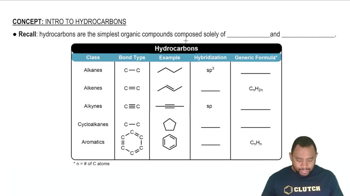
Hydrocarbons are organic compounds consisting entirely of hydrogen and carbon. They can be classified as aliphatic (straight or branched chains) or aromatic (ring structures). The number of hydrogen atoms in a hydrocarbon can be determined based on the number of carbon atoms and the types of bonds (single, double, or triple) present, following specific formulas for saturated and unsaturated hydrocarbons.
Recommended video:
Guided course
Intro To Hydrocarbons
Related Practice
Textbook Question
Textbook Question
In the Lewis structure shown here, A, D, E, Q, X, and Z represent elements in the first two rows of the periodic table. Identify all six elements so that the formal charges of all atoms are zero.
3
views
1
rank
Textbook Question
(a) True or false: An element's number of valence electrons is the same as its atomic number.
Textbook Question
Consider the Lewis structure for the polyatomic oxyanion shown here, where X is an element from the third period (Na - Ar). By changing the overall charge, n, from 1- to 2- to 3- we get three different polyatomic ions. For each of these ions (b) determine the formal charge of the central atom, X;
1
views
Textbook Question
The orbital diagram that follows shows the valence electrons for a 2+ ion of an element. (a) What is the element?
