At standard temperature and pressure, the molar volumes of Cl2 and NH3 gases are 22.06 and 22.40 L, respectively (d) Are the molar volumes in the solid state as similar as they are in the gaseous state? Explain.
Ch.11 - Liquids and Intermolecular Forces
Brown14th EditionChemistry: The Central ScienceISBN: 9780134414232Not the one you use?Change textbook
Chapter 11, Problem 13c
At standard temperature and pressure, the molar volumes of Cl2 and NH3 gases are 22.06 and 22.40 L, respectively. (c) The densities of crystalline Cl2 and NH3 at 160 K are 2.02 and 0.84 g/cm3, respectively. Calculate their molar volumes.
Verified step by step guidance1
Convert the densities from g/cm³ to g/L by multiplying the given densities by 1000, because 1 cm³ is equivalent to 0.001 L.
Use the molar mass of Cl2 (approximately 70.90 g/mol) and NH3 (approximately 17.03 g/mol) to calculate the molar volumes. The molar volume can be calculated using the formula: Molar Volume = Molar Mass / Density.
Substitute the molar mass of Cl2 and the converted density into the formula to calculate the molar volume of Cl2.
Substitute the molar mass of NH3 and the converted density into the formula to calculate the molar volume of NH3.
Ensure the units are consistent throughout the calculations and convert the final molar volumes into appropriate units if necessary.

Verified video answer for a similar problem:
This video solution was recommended by our tutors as helpful for the problem above.
Video duration:
4mWas this helpful?
Key Concepts
Here are the essential concepts you must grasp in order to answer the question correctly.
Molar Volume
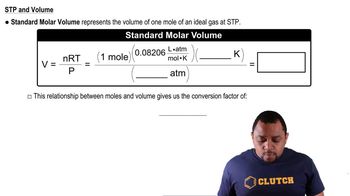
Molar volume is the volume occupied by one mole of a substance at a given temperature and pressure, typically measured in liters per mole (L/mol). At standard temperature and pressure (STP), the molar volume of an ideal gas is approximately 22.4 L/mol. This concept is crucial for understanding gas behavior and comparing the volumes of different gases under similar conditions.
Recommended video:
Guided course
Standard Molar Volume
Density
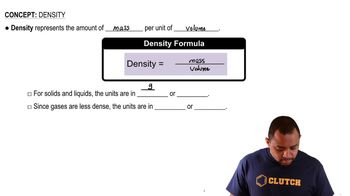
Density is defined as mass per unit volume, commonly expressed in grams per cubic centimeter (g/cm³) or kilograms per liter (kg/L). It is an important property that helps in determining how much mass of a substance is contained in a specific volume. In the context of gases, density can be used to calculate molar volume when combined with the ideal gas law.
Recommended video:
Guided course
Density Concepts
Ideal Gas Law
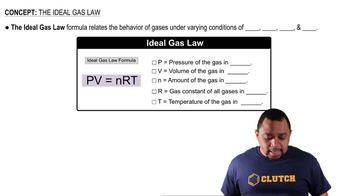
The ideal gas law is a fundamental equation in chemistry that relates the pressure, volume, temperature, and number of moles of an ideal gas, expressed as PV = nRT. This law allows for the calculation of various properties of gases, including molar volume, under different conditions. Understanding this law is essential for solving problems involving gas behavior and conversions.
Recommended video:
Guided course
Ideal Gas Law Formula
Related Practice
Textbook Question
1
views
Textbook Question
At standard temperature and pressure, the molar volumes of Cl2 and NH3 gases are 22.06 and 22.40 L, respectively (b) On cooling to 160 K, both substances form crystalline solids. Do you expect the molar volumes to decrease or increase on cooling the gases to 160 K?
Textbook Question
At room temperature, Si is a solid, CCl4 is a liquid, and Ar is a gas. List these substances in order of (a) increasing intermolecular energy of attraction
3
views
Textbook Question
Benzoic acid, C6H5COOH, melts at 122 °C. The density in the liquid state at 130 °C is 1.08 g/cm3. The density of solid benzoic acid at 15 °C is 1.266 g/cm3. (b) If you converted a cubic centimeter of liquid benzoic acid into a solid, would the solid take up more, or less, volume than the original cubic centimeter of liquid?
1
views