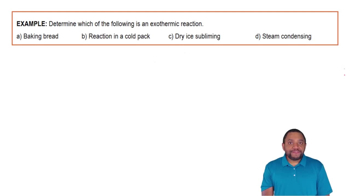
Several processes are given in the table and labeled as endo- thermic or exothermic and given a sign for ∆H°. Which process is labeled with the correct sign of ∆H° and correct classification as endothermic or exothermic? (LO 9.8) Process (c) Water freezes into ice in the freezer.
Several processes are given in the table and labeled as endo- thermic or exothermic and given a sign for ∆H°. Which process is labeled with the correct sign of ∆H° and correct classification as endothermic or exothermic? (LO 9.8) Process (d) Rubbing alcohol evaporates from your skin.
Verified step by step guidance
Verified video answer for a similar problem:
Key Concepts
Endothermic and Exothermic Processes
Enthalpy Change (∆H°)
Evaporation and Heat Transfer
Several processes are given in the table and labeled as endo- thermic or exothermic and given a sign for ∆H°. Which process is labeled with the correct sign of ∆H° and correct classification as endothermic or exothermic? (LO 9.8) Process (b) Methane, the main component of natural gas, is burned to produce a flame on a stovetop.
Several processes are given in the table and labeled as endo- thermic or exothermic and given a sign for ∆H°. Which process is labeled with the correct sign of ∆H° and correct classification as endothermic or exothermic? (LO 9.8) Process (a) Ammonium nitrate dissolves in water, and the temperature of the solution decreases.
When 12.5 g of NH4NO3 is dissolved in 150.0 g of water of 25.0 °C in a coffee cup calorimeter, the final temperature of the solution of 19.7 °C. Assume that the specific heat of the solution is the same as that of water, 4.18 J/(g•°C). What is the ΔH per mol of NH4NO3? (LO 9.10) NH4NO3 (s) → NH4+ (aq) + NO3−(aq) ΔH = ? (a) +3.60 kJ (b) +23.0 kJ (c) +21.3 kJ (d) −3.60 kJ
