Join thousands of students who trust us to help them ace their exams!
Multiple Choice
If 53.2kJ of heat are added to a 15.5g ice cube at - 5.00 oC, what will be the resulting state and temperature of the substance?
A
322.5°C, gas
B
-3.70ºC, solid
C
98.82 ºC, liquid
D
222.5 ºC, gas
0 Comments
Verified step by step guidance
1
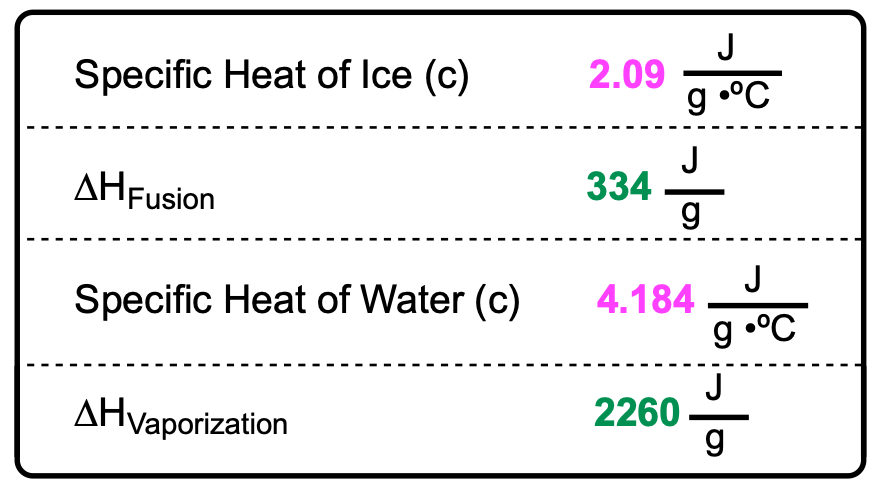
Step 1: Calculate the heat required to raise the temperature of the ice from -5.00°C to 0°C using the formula \(q = m \times c_{ice} \times \Delta T\), where \(m = 15.5\,g\), \(c_{ice} = 2.09\,\frac{J}{g\cdot ^\circ C}\), and \(\Delta T = 0 - (-5.00) = 5.00\, ^\circ C\).
Step 2: Calculate the heat required to melt the ice at 0°C to liquid water using the enthalpy of fusion: \(q = m \times \Delta H_{fusion}\), where \(\Delta H_{fusion} = 334\,\frac{J}{g}\).
Step 3: Calculate the heat required to raise the temperature of the resulting water from 0°C to 100°C using \(q = m \times c_{water} \times \Delta T\), where \(c_{water} = 4.184\,\frac{J}{g\cdot ^\circ C}\) and \(\Delta T = 100 - 0 = 100\, ^\circ C\).
Step 4: Calculate the heat required to vaporize the water at 100°C to steam using the enthalpy of vaporization: \(q = m \times \Delta H_{vaporization}\), where \(\Delta H_{vaporization} = 2260\,\frac{J}{g}\).
Step 5: Compare the total heat added (53.2 kJ = 53200 J) with the cumulative heat required for each step. Determine the final state and temperature by subtracting the heat used in each phase change and temperature increase stepwise until the heat is exhausted.


 Verified step by step guidance