Skip to main content
Financial Accounting
My Course
Learn
Exam Prep
AI Tutor
Study Guides
Flashcards
Explore
Try the app
My Course
Learn
Exam Prep
AI Tutor
Study Guides
Flashcards
Explore
Try the app
Back
Ratios: Quality of Earnings Ratio definitions
You can tap to flip the card.
Quality of Earnings Ratio
You can tap to flip the card.
👆
Quality of Earnings Ratio
Comparison of net cash flow from operating activities to net income, used to assess the reliability of reported profits.
Track progress
Control buttons has been changed to "navigation" mode.
1/15
Related flashcards
Related practice
Recommended videos
Ratios: Quality of Earnings Ratio quiz
Ratios: Quality of Earnings Ratio
15 Terms
Ratios: Quality of Earnings Ratio
14. Financial Statement Analysis
10 problems
Topic
Ratios: Inventory Turnover
14. Financial Statement Analysis
10 problems
Topic
14. Financial Statement Analysis
15 topics
15 problems
Chapter
Guided course
06:28
Ratios: Quality of Earnings Ratio and Earnings Management
4
views
Terms in this set (15)
Hide definitions
Quality of Earnings Ratio
Comparison of net cash flow from operating activities to net income, used to assess the reliability of reported profits.
Net Income
Amount of profit remaining after all expenses, taxes, and costs are subtracted from total revenue.
Cash Flow from Operations
Cash generated by a company's core business activities, excluding investing and financing transactions.
Accrual Accounting
Accounting method where revenues and expenses are recorded when earned or incurred, not when cash is exchanged.
Earnings Quality
Degree to which reported income reflects actual, sustainable business performance and cash generation.
Earnings Management
Deliberate actions by management to influence reported earnings, often to present a more favorable financial picture.
Channel Stuffing
Practice of pushing excess products to distributors near period-end to inflate sales figures temporarily.
Statement of Cash Flows
Financial report detailing cash inflows and outflows from operating, investing, and financing activities.
Operating Activities
Day-to-day business functions that generate revenue and incur expenses, forming the core of cash flow analysis.
Investing Activities
Transactions involving the purchase or sale of long-term assets like equipment, land, or securities.
Financing Activities
Transactions with creditors and investors, such as issuing stock, borrowing, or repaying debt.
Accounts Receivable
Amounts owed to a company by customers for goods or services delivered but not yet paid for.
Transparency
Clarity and openness in financial reporting, allowing stakeholders to understand how figures are derived.
One-Time Gains
Nonrecurring profits from unusual events, such as asset sales, that can temporarily boost reported earnings.
Profitability Ratio
Metric used to evaluate a company's ability to generate earnings relative to revenue, assets, or equity.
 BackBack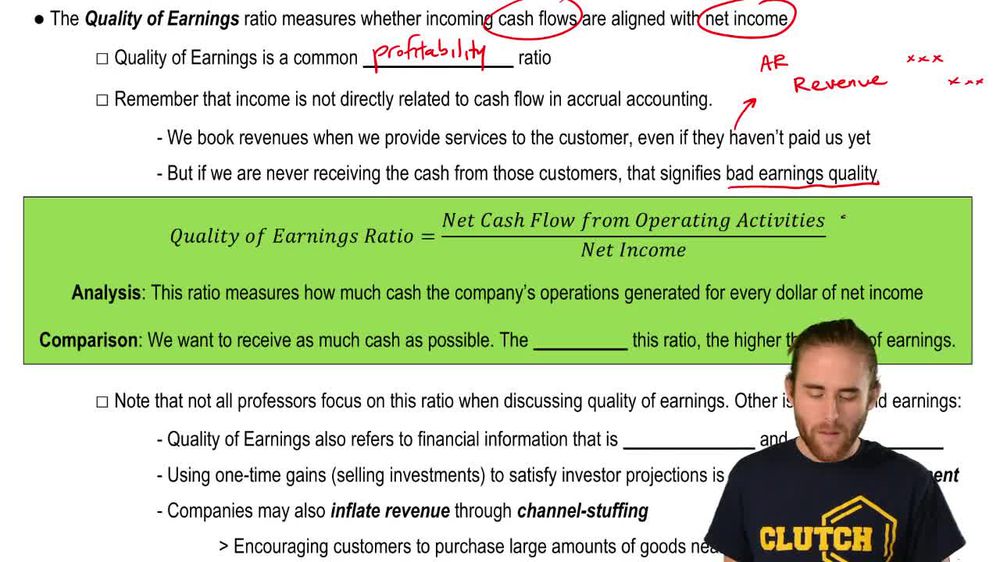
 06:28
06:28