Skip to main content
Financial Accounting
My Course
Learn
Exam Prep
AI Tutor
Study Guides
Flashcards
Explore
Try the app
My Course
Learn
Exam Prep
AI Tutor
Study Guides
Flashcards
Explore
Try the app
Back
Ratios: Economic Return from Investing quiz
You can tap to flip the card.
What is the Economic Return of Investing ratio used to analyze?
You can tap to flip the card.
👆
What is the Economic Return of Investing ratio used to analyze?
It is used by investors to analyze their profits from investments, focusing on dividends, capital appreciation, and initial investment costs.
Track progress
Control buttons has been changed to "navigation" mode.
1/15
Related flashcards
Related practice
Recommended videos
Ratios: Economic Return from Investing definitions
Ratios: Economic Return from Investing
14 Terms
Ratios: Economic Return from Investing
14. Financial Statement Analysis
10 problems
Topic
Ratios: Capital Acquisition Ratio
14. Financial Statement Analysis
10 problems
Topic
14. Financial Statement Analysis
15 topics
15 problems
Chapter
Guided course
03:51
Ratios: Economic Return from Investing
3
views
Terms in this set (15)
Hide definitions
What is the Economic Return of Investing ratio used to analyze?
It is used by investors to analyze their profits from investments, focusing on dividends, capital appreciation, and initial investment costs.
Does the Economic Return of Investing ratio directly use financial statements?
No, it considers the investor's perspective and does not directly use financial statements.
What are the two main sources of profit included in the numerator of the Economic Return of Investing?
The numerator includes dividends and interest received, plus any change in the fair value of the investment (capital gains or losses).
What does capital appreciation represent in the Economic Return of Investing ratio?
Capital appreciation reflects gains or losses from changes in the investment's fair value.
How is the denominator of the Economic Return of Investing ratio determined?
The denominator is the original cost or the fair value of the investment at the beginning of the period.
How is the Economic Return of Investing ratio typically expressed?
It is typically expressed as a percentage, indicating profit or loss per dollar invested.
What must you do to convert the Economic Return of Investing ratio into a percentage?
Multiply the result by 100 to convert it into a percentage.
Why is understanding the Economic Return of Investing ratio important for investors?
It helps investors gauge how much they earn or lose for each dollar invested, providing a clear picture of investment performance.
What does receiving dividends represent for an investor?
Dividends provide cash returns from investments, representing one source of profit.
What is the significance of interest received in the Economic Return of Investing ratio?
Interest received is included in the numerator and applies when the investment is a bond or similar instrument.
If an investment's fair value increases from \$20 to \$30, what is the capital gain?
The capital gain is \$10, representing the increase in value from \$20 to \$30.
If an investment's fair value decreases from \$20 to \$15, what is the capital loss?
The capital loss is \$5, representing the decrease in value from \$20 to \$15.
What does the Economic Return of Investing ratio show about profits or losses?
It shows the amount of profit or loss per dollar invested, based on the starting value.
What does a 5% Economic Return of Investing mean for each dollar invested?
It means the investor earns 5 cents in profit for each dollar invested.
Who can use the Economic Return of Investing ratio besides individual investors?
Companies can use it when they are the investor, such as when buying short-term investments.
 BackBack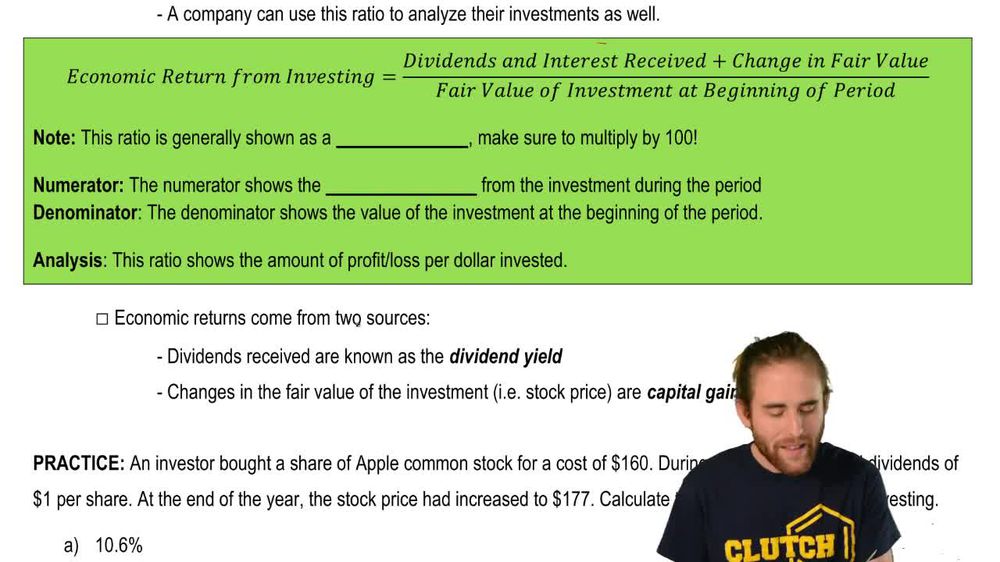
 03:51
03:51