Skip to main content
Financial Accounting
My Course
Learn
Exam Prep
AI Tutor
Study Guides
Flashcards
Explore
Try the app
My Course
Learn
Exam Prep
AI Tutor
Study Guides
Flashcards
Explore
Try the app
Back
Ratios: Average Collection Period (Days Sales Outstanding) definitions
You can tap to flip the card.
Average Collection Period
You can tap to flip the card.
👆
Average Collection Period
Represents the typical number of days a receivable remains outstanding before being collected from customers.
Track progress
Control buttons has been changed to "navigation" mode.
1/15
Related flashcards
Related practice
Recommended videos
Ratios: Average Collection Period (Days Sales Outstanding) quiz #1
Ratios: Average Collection Period (Days Sales Outstanding)
10 Terms
Ratios: Average Collection Period (Days Sales Outstanding)
14. Financial Statement Analysis
10 problems
Topic
Ratios: Return on Assets (ROA)
14. Financial Statement Analysis
10 problems
Topic
14. Financial Statement Analysis
15 topics
15 problems
Chapter
Guided course
06:53
Ratios: Average Collection Period (Days Sales Outstanding)
2
views
Terms in this set (15)
Hide definitions
Average Collection Period
Represents the typical number of days a receivable remains outstanding before being collected from customers.
Days Sales Outstanding
Alternative name for the metric showing the average time it takes to collect payment after a credit sale.
Accounts Receivable
Represents amounts owed by customers for credit sales, temporarily tying up company funds until collected.
Efficiency Ratio
Category of financial metrics used to assess how effectively a company manages its assets and operations.
Accounts Receivable Turnover Ratio
Indicates how many times, on average, receivables are collected during a period, reflecting collection efficiency.
Net Credit Sales
Total sales made on credit, minus returns and allowances, forming the numerator in the AR turnover calculation.
Average Accounts Receivable
Calculated by adding beginning and ending receivable balances and dividing by two, used in turnover formulas.
Benchmarking
Process of comparing a company's performance metrics to industry averages or competitors to assess effectiveness.
Industry Average
Represents the typical value for a metric within a specific sector, used as a standard for comparison.
Contra Account
Account that reduces the balance of a related account, such as allowances that lower accounts receivable.
Credit Sales
Transactions where goods or services are sold with payment to be received at a later date.
Inventory Replenishment
Process of restocking goods, which can be delayed if funds are tied up in uncollected receivables.
Numerator
Top part of a fraction in a ratio calculation, such as net sales in the AR turnover formula.
Denominator
Bottom part of a fraction in a ratio calculation, such as average accounts receivable in turnover ratios.
Collection Performance
Assessment of how quickly and efficiently a company receives payments from its customers.
 BackBack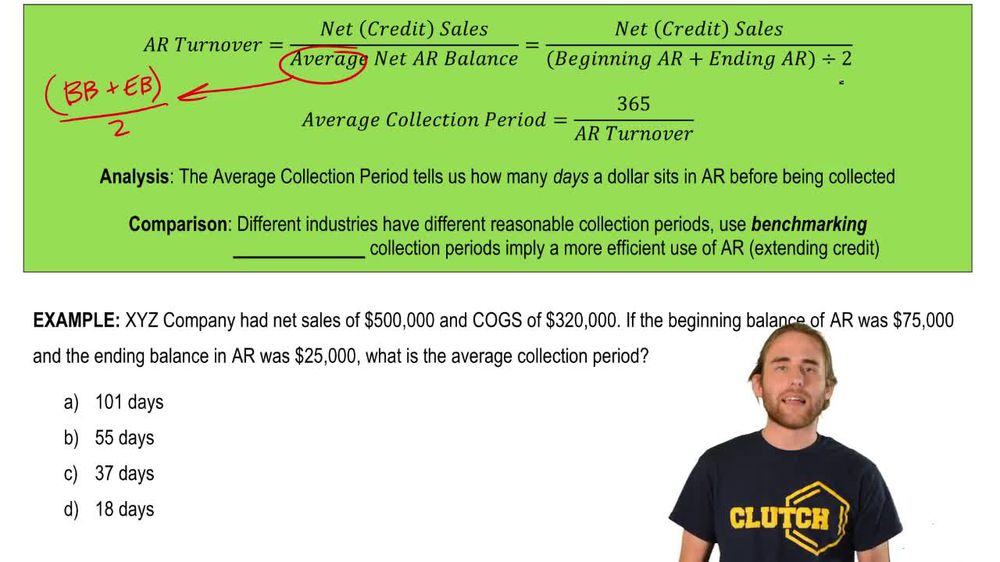
 06:53
06:53