Financial Accounting
My Course
Learn
Exam Prep
AI Tutor
Study Guides
Flashcards
Explore
Try the app
My Course
Learn
Exam Prep
AI Tutor
Study Guides
Flashcards
Explore
Try the app
Back
Net Accounts Receivable: Aging of Receivables Method definitions
You can tap to flip the card.
Aging of Receivables Method
You can tap to flip the card.
👆
Aging of Receivables Method
Balance sheet approach estimating uncollectible accounts by categorizing receivables based on age and applying specific uncollectibility percentages.
Track progress
Control buttons has been changed to "navigation" mode.
1/15
Related flashcards
Related practice
Recommended videos
Net Accounts Receivable: Aging of Receivables Method quiz #1
Net Accounts Receivable: Aging of Receivables Method
12 Terms
Notes Receivable
7. Receivables and Investments
10 problems
Topic
7. Receivables and Investments
10 topics
15 problems
Chapter
Guided course
07:36
Net Accounts Receivable: Aging of Receivables Method
8
views
1
rank
Terms in this set (15)
Hide definitions
Aging of Receivables Method
Balance sheet approach estimating uncollectible accounts by categorizing receivables based on age and applying specific uncollectibility percentages.
Allowance for Doubtful Accounts
Contra-asset account reflecting the estimated amount of accounts receivable expected to be uncollectible.
Bad Debt Expense
Amount recognized in the period to adjust the allowance for doubtful accounts to the required ending balance.
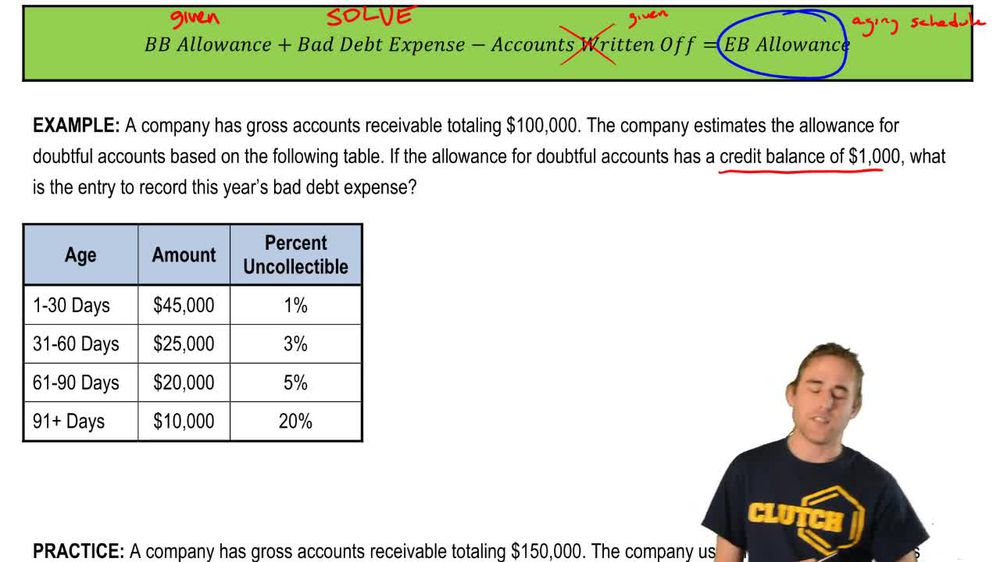
Aging Schedule
Table categorizing accounts receivable by age groups and assigning uncollectibility percentages to each group.
Uncollectibility Percentage
Estimated likelihood that receivables in a specific age category will not be collected.
Gross Accounts Receivable
Total outstanding amounts owed to a company by customers before deducting any allowance for doubtful accounts.
Balance Sheet Approach
Method focusing on estimating uncollectible accounts based on the accounts receivable balance rather than sales.
Ending Balance
Final amount in the allowance for doubtful accounts after considering beginning balance, bad debt expense, and write-offs.
Beginning Balance
Amount in the allowance for doubtful accounts at the start of the period, used in calculating adjustments.
Write-offs
Amounts removed from accounts receivable and the allowance for doubtful accounts when deemed uncollectible.
Journal Entry
Accounting record debiting bad debt expense and crediting allowance for doubtful accounts to reflect estimated uncollectibles.
Contra-asset Account
Account that reduces the balance of a related asset, such as the allowance for doubtful accounts reducing accounts receivable.
Net Accounts Receivable
Amount expected to be collected from customers, calculated as gross accounts receivable minus the allowance for doubtful accounts.
Credit Balance
Normal balance for the allowance for doubtful accounts, indicating the amount set aside for potential uncollectibles.
Age Category
Grouping of receivables based on how long amounts have been outstanding, used to assess collection risk.