Skip to main content
Financial Accounting
My Course
Learn
Exam Prep
AI Tutor
Study Guides
Flashcards
Explore
Try the app
My Course
Learn
Exam Prep
AI Tutor
Study Guides
Flashcards
Explore
Try the app
Back
Introduction to Investments in Securities definitions
You can tap to flip the card.
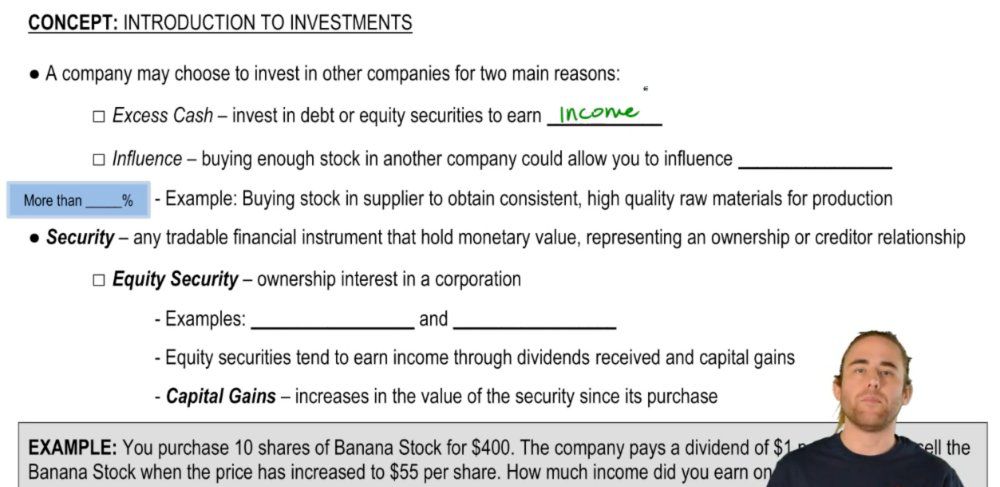
Security
You can tap to flip the card.
👆
Security
A financial instrument representing either ownership in a company or a creditor relationship, such as stocks or bonds.
Track progress
Control buttons has been changed to "navigation" mode.
1/15
Related flashcards
Related practice
Recommended videos
Introduction to Investments in Securities quiz #1
Introduction to Investments in Securities
40 Terms
Introduction to Investments in Securities quiz #2
Introduction to Investments in Securities
14 Terms
Introduction to Investments in Securities
7. Receivables and Investments
9 problems
Topic
Trading Securities
7. Receivables and Investments
10 problems
Topic
7. Receivables and Investments - Part 1 of 2
10 topics
15 problems
Chapter
7. Receivables and Investments - Part 2 of 2
1 topic
3 problems
Chapter
Guided course
06:41
Investment Classification Summary
5
views
Guided course
06:41
Introduction to Cost Method Investments
4
views
Terms in this set (15)
Hide definitions
Security
A financial instrument representing either ownership in a company or a creditor relationship, such as stocks or bonds.
Equity Security
An investment that signifies ownership interest in a company, typically through common or preferred stock.
Debt Security
A financial asset representing a loan made to another entity, usually in the form of bonds, with repayment plus interest.
Dividend
A distribution of a company's earnings to shareholders, providing income to those holding equity securities.
Capital Gain
The profit realized from selling an investment at a price higher than its purchase cost.
Trading Security
A short-term investment intended for active buying and selling, with changes in value reported on the income statement.
Held to Maturity
A classification for debt investments intended to be kept until their maturity date, recorded at amortized cost.
Available for Sale
A category for securities not actively traded but available for sale, with value changes reported in other comprehensive income.
Fair Value
The current market price of an asset, used to adjust the value of certain securities on financial statements.
Unrealized Gain
An increase in the value of an investment that has not yet been sold, affecting financial statements differently by classification.
Unrealized Loss
A decrease in the value of an investment that remains unsold, with reporting dependent on the security's classification.
Amortized Cost
The adjusted value of a debt investment on the books, reflecting principal and any premium or discount over time.
Other Comprehensive Income
A section of equity where certain gains or losses, such as those from available for sale securities, are reported outside net income.
Balance Sheet
A financial statement showing a company's assets, liabilities, and equity, including the classification of investments.
Interest
The return earned from lending money through debt securities, typically paid periodically by the borrower.
 BackBack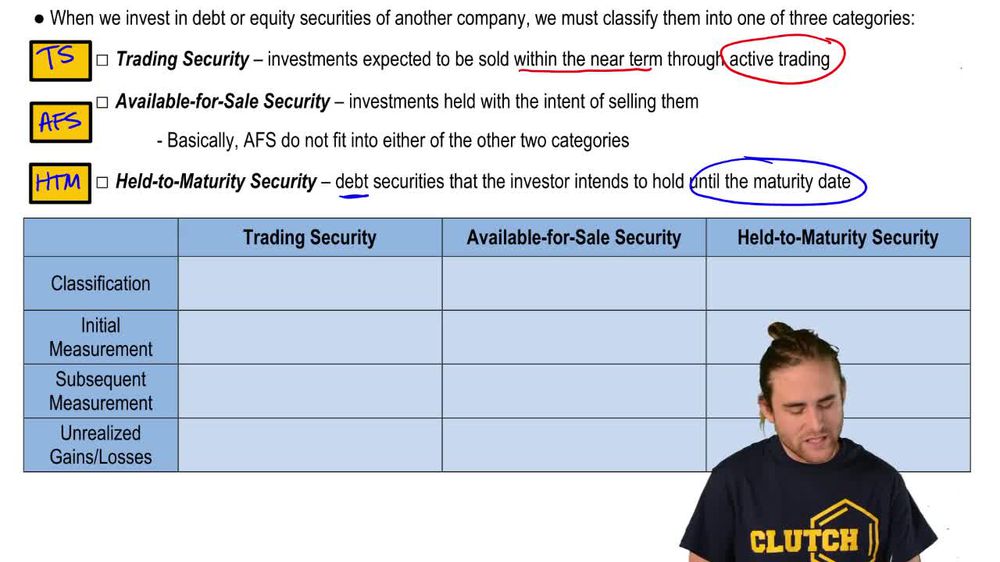
 06:41
06:41