Skip to main content
Financial Accounting
My Course
Learn
Exam Prep
AI Tutor
Study Guides
Flashcards
Explore
Try the app
My Course
Learn
Exam Prep
AI Tutor
Study Guides
Flashcards
Explore
Try the app
Back
GAAP vs. IFRS: Fraud, Internal Controls, and Cash quiz
You can tap to flip the card.
Who sets the GAAP standards in the USA?
You can tap to flip the card.
👆
Who sets the GAAP standards in the USA?
The Financial Accounting Standards Board (FASB) sets the GAAP standards in the USA.
Track progress
Control buttons has been changed to "navigation" mode.
1/15
Related flashcards
Related practice
Recommended videos
GAAP vs. IFRS: Fraud, Internal Controls, and Cash definitions
GAAP vs. IFRS: Fraud, Internal Controls, and Cash
14 Terms
GAAP vs. IFRS: Fraud, Internal Controls, and Cash
15. GAAP vs IFRS
10 problems
Topic
GAAP vs. IFRS: Receivables
15. GAAP vs IFRS
10 problems
Topic
15. GAAP vs IFRS
13 topics
13 problems
Chapter
Guided course
03:03
GAAP vs. IFRS: Fraud, Internal Controls, and Cash
6
views
Terms in this set (15)
Hide definitions
Who sets the GAAP standards in the USA?
The Financial Accounting Standards Board (FASB) sets the GAAP standards in the USA.
Which organization is responsible for setting IFRS internationally?
The International Accounting Standards Board (IASB) is responsible for setting IFRS internationally.
What is the main purpose of internal controls under both GAAP and IFRS?
The main purpose of internal controls is to help prevent fraud within a company.
How are cash and cash equivalents typically reported under both GAAP and IFRS?
Cash and cash equivalents are usually reported together on the balance sheet under both GAAP and IFRS.
What qualifies as a cash equivalent under GAAP and IFRS?
A cash equivalent is a very liquid investment that matures in under 90 days.
What internal control procedure over cash is emphasized by both GAAP and IFRS?
Both GAAP and IFRS emphasize the importance of bank reconciliations as an internal control procedure over cash.
What major US law was enacted in response to accounting scandals like Enron and Worldcom?
The Sarbanes-Oxley Act was enacted in response to these scandals.
What is the main focus of the Sarbanes-Oxley Act?
The Sarbanes-Oxley Act focuses on imposing stricter internal controls and financial reporting standards for US companies.
Does the Sarbanes-Oxley Act apply to companies outside the USA?
No, the Sarbanes-Oxley Act only applies to companies listed on US stock exchanges.
Are the rules for cash equivalents the same under GAAP and IFRS?
Yes, the rules for cash equivalents are generally the same under both GAAP and IFRS.
Why was the Sarbanes-Oxley Act created?
It was created to enhance transparency and accountability in financial reporting by US companies.
Do all companies in the US have to follow the Sarbanes-Oxley Act?
No, only public companies listed on US stock exchanges are required to follow the Sarbanes-Oxley Act.
What is a key similarity between GAAP and IFRS regarding fraud prevention?
Both require strong internal controls to help prevent fraud.
Who must comply with the stricter standards imposed by the Sarbanes-Oxley Act?
Public companies listed on US stock exchanges must comply with these stricter standards.
What is the main difference between GAAP and IFRS in terms of internal controls and fraud?
The main difference is the existence of the Sarbanes-Oxley Act, which imposes stricter controls only in the US.
 BackBack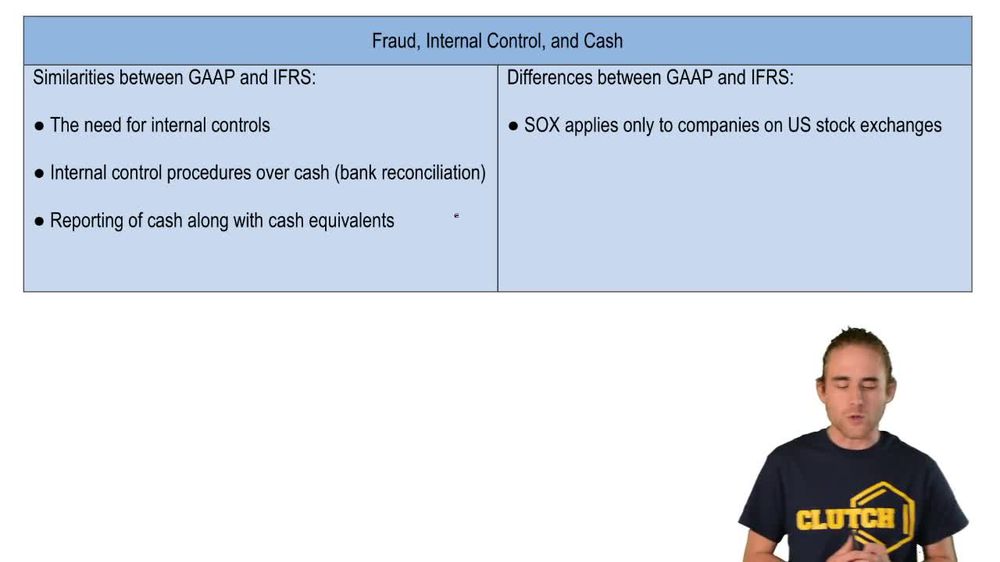
 03:03
03:03