Ch. R - Review of Basic Concepts
Lial - College Algebra 13th Edition
Lial13th EditionCollege AlgebraISBN: 9780136881063Not the one you use?Change textbook
Chapter 1, Problem 65

Use the rules for radicals to perform the indicated operations. Assume all variable expressions represent positive real numbers. ∛√4

Verified step by step guidance
1
Recognize that the expression involves nested radicals: the cube root of the square root of 4, which can be written as \(\sqrt[3]{\sqrt{4}}\).
Rewrite the square root as an exponent: \(\sqrt{4} = 4^{\frac{1}{2}}\).
Substitute this back into the original expression: \(\sqrt[3]{4^{\frac{1}{2}}}\).
Use the rule for radicals that \(\sqrt[n]{a^m} = a^{\frac{m}{n}}\) to combine the radicals: \(\left(4^{\frac{1}{2}}\right)^{\frac{1}{3}} = 4^{\frac{1}{2} \times \frac{1}{3}}\).
Multiply the exponents: \(4^{\frac{1}{6}}\), which is the simplified form of the original expression.

Verified video answer for a similar problem:

This video solution was recommended by our tutors as helpful for the problem above.
Video duration:
1m
Was this helpful?

Key Concepts

Here are the essential concepts you must grasp in order to answer the question correctly.

Radical Expressions and Notation

Radical expressions involve roots such as square roots (√) and cube roots (∛). The index of the root indicates the degree, with √ representing a square root (index 2) and ∛ representing a cube root (index 3). Understanding how to interpret and write these expressions is fundamental to manipulating them.
Recommended video:
Guided course
05:45
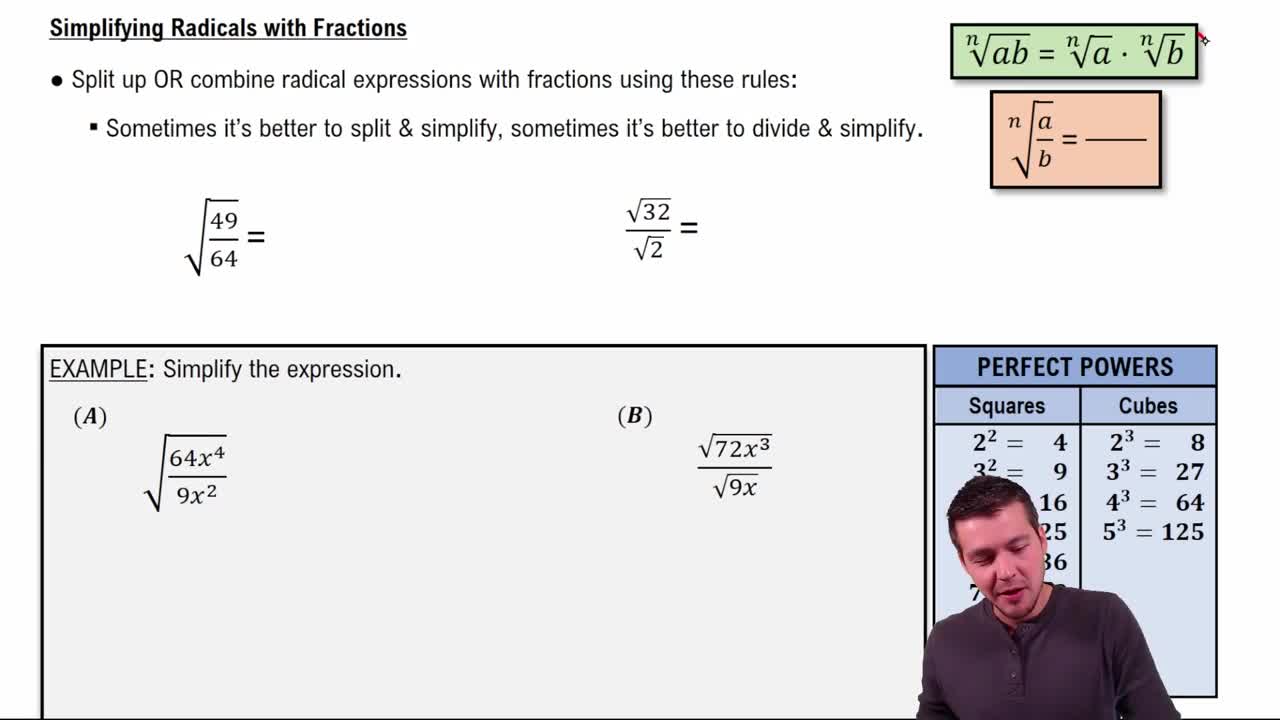
Radical Expressions with Fractions

Rules for Radicals (Product and Power Rules)

The rules for radicals allow simplification and combination of roots. The product rule states that the root of a product equals the product of the roots, e.g., √a * √b = √(ab). The power rule lets you rewrite radicals as fractional exponents, such as √a = a^(1/2) and ∛a = a^(1/3), facilitating easier operations.
Recommended video:

Converting Between Radical and Exponential Forms

Expressing radicals as fractional exponents helps simplify complex expressions. For example, √4 can be written as 4^(1/2), and ∛(4^(1/2)) becomes 4^(1/2 * 1/3) = 4^(1/6). This conversion is key to performing operations like multiplication or composition of radicals efficiently.
Recommended video:
04:34
Converting Standard Form to Vertex Form