Ch. R - Review of Basic Concepts
Lial - College Algebra 13th Edition
Lial13th EditionCollege AlgebraISBN: 9780136881063Not the one you use?Change textbook
Chapter 1, Problem 20a

Use specific values for x and y to show that, in general, 1/x + 1/y is not equivalent to 1 / x + y.

Verified step by step guidance
1
Start by choosing specific values for \( x \) and \( y \). For example, let \( x = 2 \) and \( y = 3 \).
Calculate the left side of the expression: \( \frac{1}{x} + \frac{1}{y} \). Substitute the values to get \( \frac{1}{2} + \frac{1}{3} \).
Calculate the right side of the expression: \( \frac{1}{x + y} \). Substitute the values to get \( \frac{1}{2 + 3} = \frac{1}{5} \).
Simplify the left side by finding a common denominator: \( \frac{1}{2} + \frac{1}{3} = \frac{3}{6} + \frac{2}{6} = \frac{5}{6} \).
Compare the two results: \( \frac{5}{6} \) (left side) and \( \frac{1}{5} \) (right side). Since these are not equal, this shows that \( \frac{1}{x} + \frac{1}{y} \) is not equivalent to \( \frac{1}{x + y} \) in general.

Verified video answer for a similar problem:

This video solution was recommended by our tutors as helpful for the problem above.
Video duration:
9m
Was this helpful?

Key Concepts

Here are the essential concepts you must grasp in order to answer the question correctly.

Properties of Fractions and Addition

Understanding how fractions are added is essential. When adding fractions like 1/x and 1/y, you must find a common denominator, resulting in (y + x) / (xy), which differs from simply adding denominators. This highlights that fraction addition is not the same as adding denominators directly.
Recommended video:
5:36
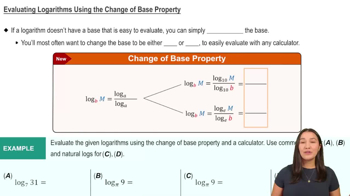
Change of Base Property

Substitution of Specific Values

Using specific numerical values for variables helps verify or disprove algebraic equivalences. By substituting numbers for x and y, you can compute both expressions and compare results, demonstrating whether the expressions are equivalent or not.
Recommended video:
Guided course
5:48
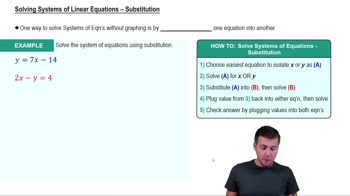
Solving Systems of Equations - Substitution

Algebraic Expression Equivalence

Two algebraic expressions are equivalent if they yield the same value for all permissible variable values. Showing that 1/x + 1/y differs from 1/(x + y) for some values of x and y proves they are not equivalent expressions.
Recommended video:
Guided course
05:09
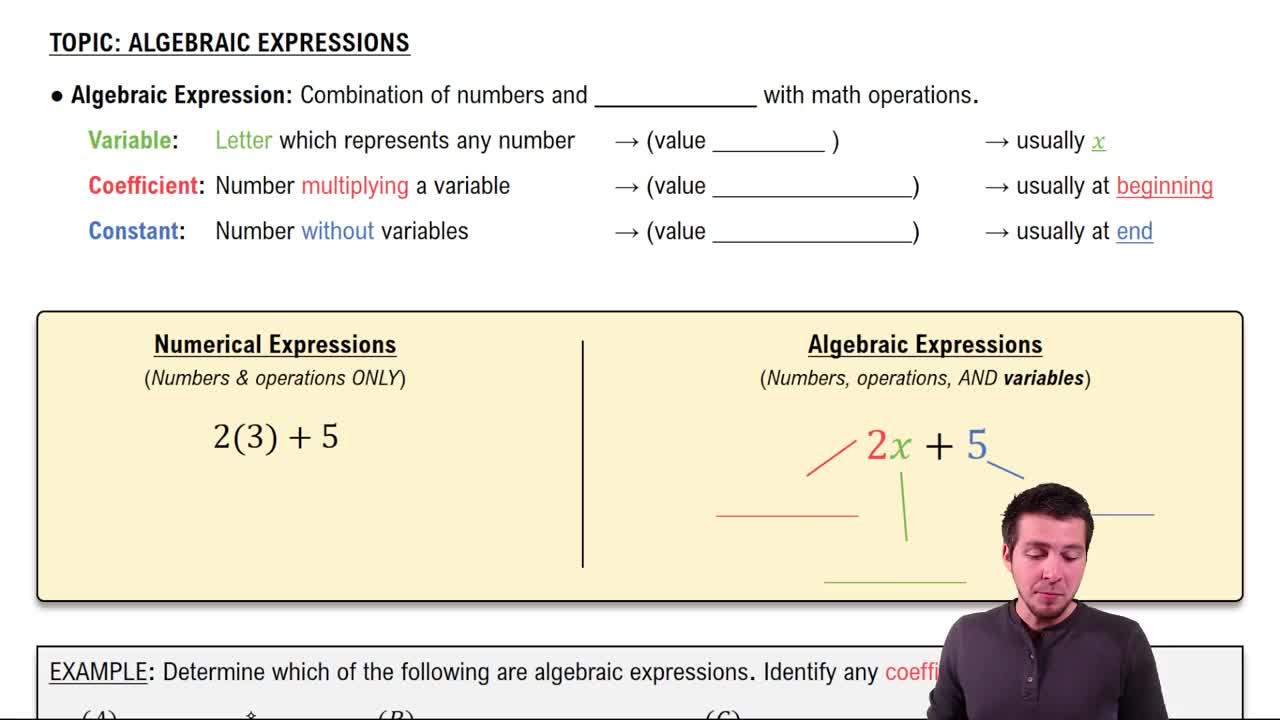
Introduction to Algebraic Expressions