Ch. R - Review of Basic Concepts
Lial - College Algebra 13th Edition
Lial13th EditionCollege AlgebraISBN: 9780136881063Not the one you use?Change textbook
Chapter 1, Problem 83a

Simplify each complex fraction. [ (y+3)/y - 4/(y-1) ] / [ y/(y - 1) + 1/y ]

Verified step by step guidance
1
Identify the complex fraction: the numerator is \(\frac{y+3}{y} - \frac{4}{y-1}\) and the denominator is \(\frac{y}{y-1} + \frac{1}{y}\).
Find a common denominator for the numerator terms, which are \(\frac{y+3}{y}\) and \(\frac{4}{y-1}\). The common denominator is \(y(y-1)\). Rewrite each fraction with this common denominator:
\[\frac{(y+3)(y-1)}{y(y-1)} - \frac{4y}{y(y-1)}.\]
Combine the numerator fractions into a single fraction by subtracting the numerators over the common denominator:
\[\frac{(y+3)(y-1) - 4y}{y(y-1)}.\]
Similarly, find a common denominator for the denominator terms \(\frac{y}{y-1}\) and \(\frac{1}{y}\), which is also \(y(y-1)\). Rewrite each fraction:
\[\frac{y^2}{y(y-1)} + \frac{y-1}{y(y-1)}.\]
Combine the denominator fractions into a single fraction by adding the numerators over the common denominator:
\[\frac{y^2 + (y-1)}{y(y-1)}.\]
Now, rewrite the original complex fraction as a division of two single fractions:
\[\frac{\frac{(y+3)(y-1) - 4y}{y(y-1)}}{\frac{y^2 + (y-1)}{y(y-1)}} = \frac{(y+3)(y-1) - 4y}{y(y-1)} \div \frac{y^2 + (y-1)}{y(y-1)}.\]
Recall that dividing by a fraction is the same as multiplying by its reciprocal. So rewrite the expression as:
\[\frac{(y+3)(y-1) - 4y}{y(y-1)} \times \frac{y(y-1)}{y^2 + (y-1)}.\]
Cancel the common factors \(y(y-1)\) in numerator and denominator, then simplify the remaining expressions by expanding and combining like terms.

Verified video answer for a similar problem:

This video solution was recommended by our tutors as helpful for the problem above.
Video duration:
8m
Was this helpful?

Key Concepts

Here are the essential concepts you must grasp in order to answer the question correctly.

Complex Fractions

A complex fraction is a fraction where the numerator, denominator, or both contain fractions themselves. Simplifying involves rewriting the expression as a single fraction by combining the smaller fractions in the numerator and denominator before dividing.
Recommended video:
05:33
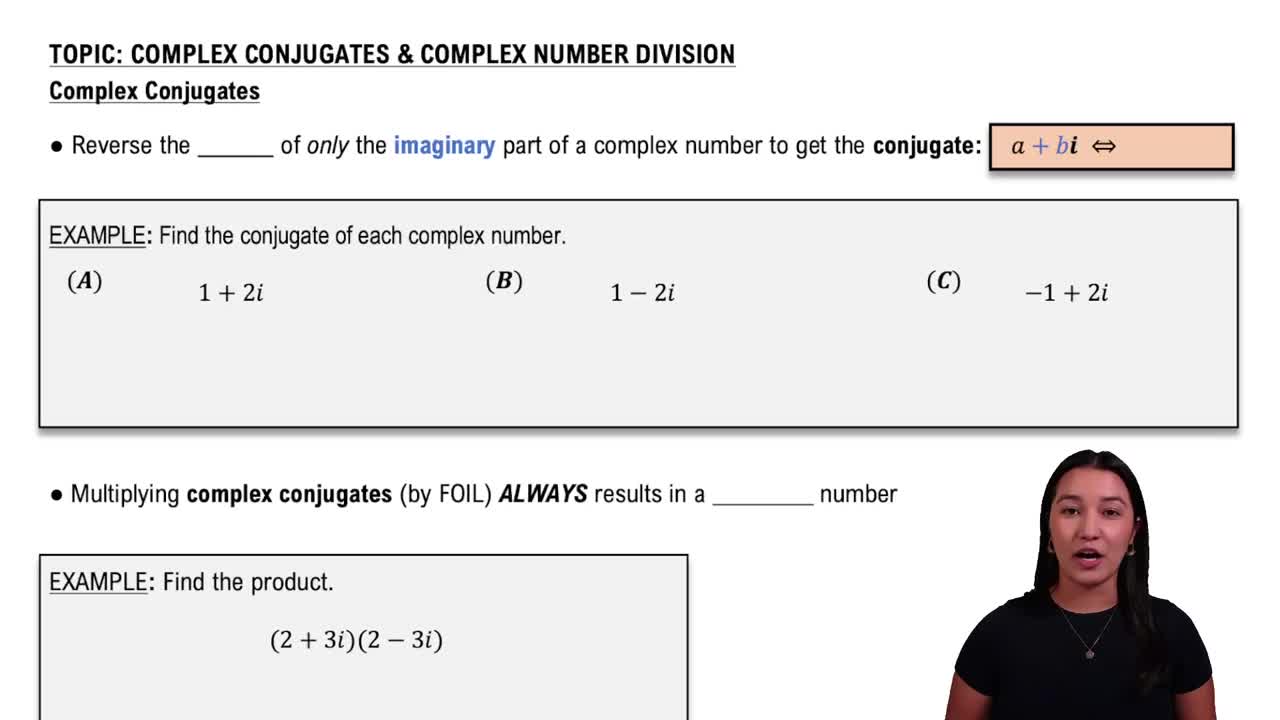
Complex Conjugates

Finding a Common Denominator

To add or subtract fractions, you must find a common denominator, which is a shared multiple of the denominators involved. This allows you to rewrite each fraction with the same denominator, making it possible to combine them into a single fraction.
Recommended video:
Guided course
02:58
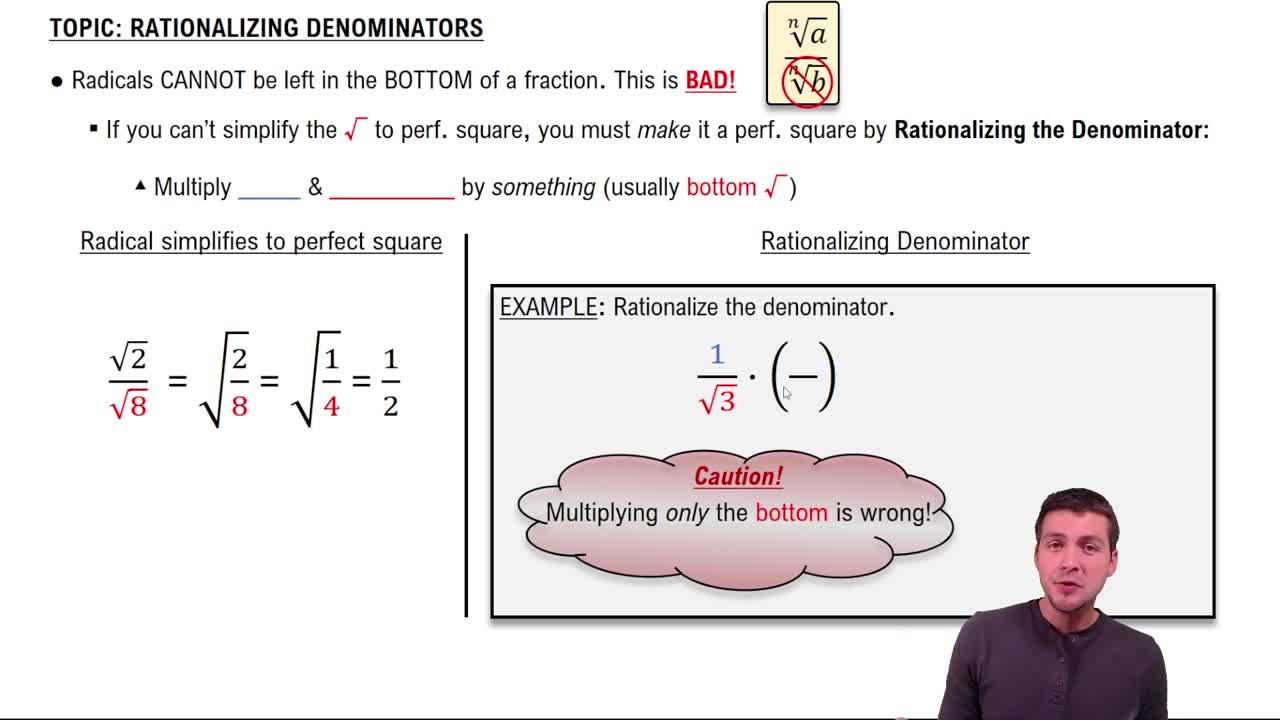
Rationalizing Denominators

Dividing Fractions

Dividing by a fraction is equivalent to multiplying by its reciprocal. After simplifying the numerator and denominator separately, you divide the two fractions by multiplying the numerator by the reciprocal of the denominator.
Recommended video:
04:22
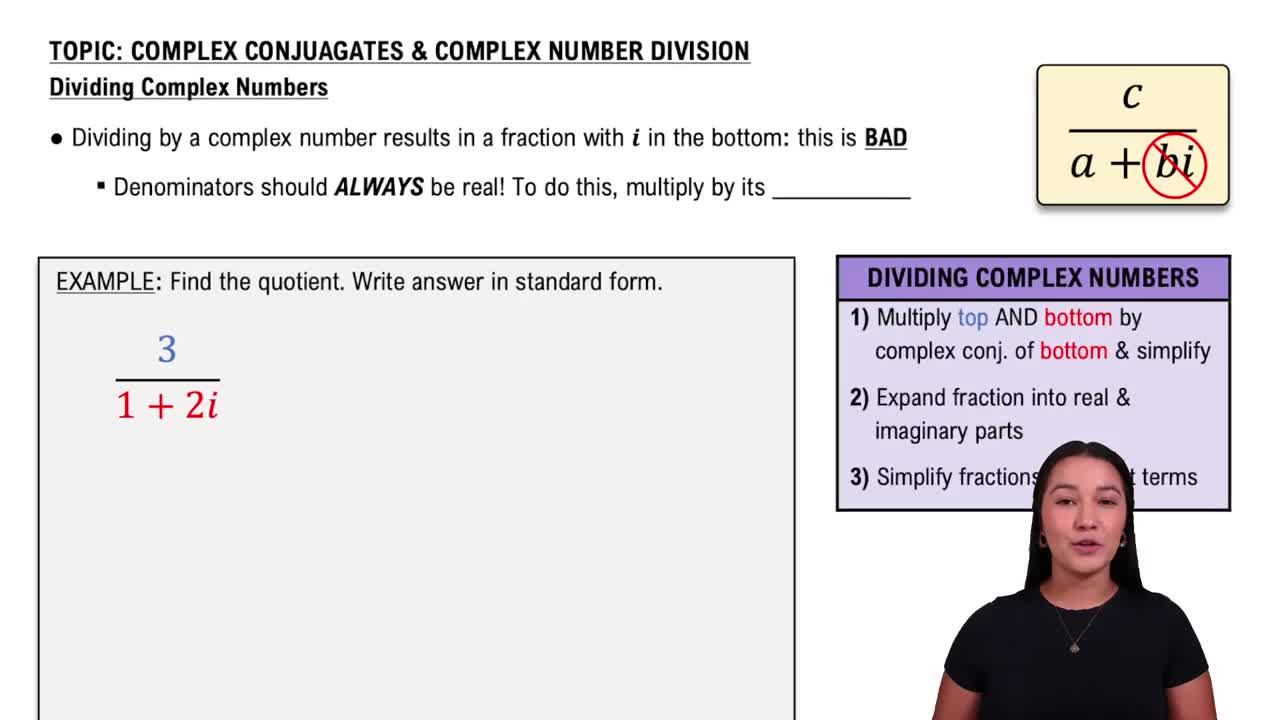
Dividing Complex Numbers