Ch. R - Review of Basic Concepts
Lial - College Algebra 13th Edition
Lial13th EditionCollege AlgebraISBN: 9780136881063Not the one you use?Change textbook
Chapter 1, Problem 121

Perform the indicated operations. Assume all variables represent positive real numbers. (∛11 - 1) (∛11² + ∛11 +1)

Verified step by step guidance
1
Recognize that the expression is of the form \((\sqrt[3]{a} - 1)(\sqrt[3]{a}^2 + \sqrt[3]{a} + 1)\), where \(a = 11\).
Recall the factorization identity for the difference of cubes: $(x - y)(x^2 + xy + y^2) = x^3 - y^3$.
Identify \(x = \sqrt[3]{11}\) and \(y = 1\) in the given expression.
Apply the difference of cubes formula: \((\sqrt[3]{11})^3 - 1^3\).
Simplify the cubes: \(11 - 1\).

Verified video answer for a similar problem:

This video solution was recommended by our tutors as helpful for the problem above.
Video duration:
5m

Key Concepts

Here are the essential concepts you must grasp in order to answer the question correctly.

Properties of Radicals

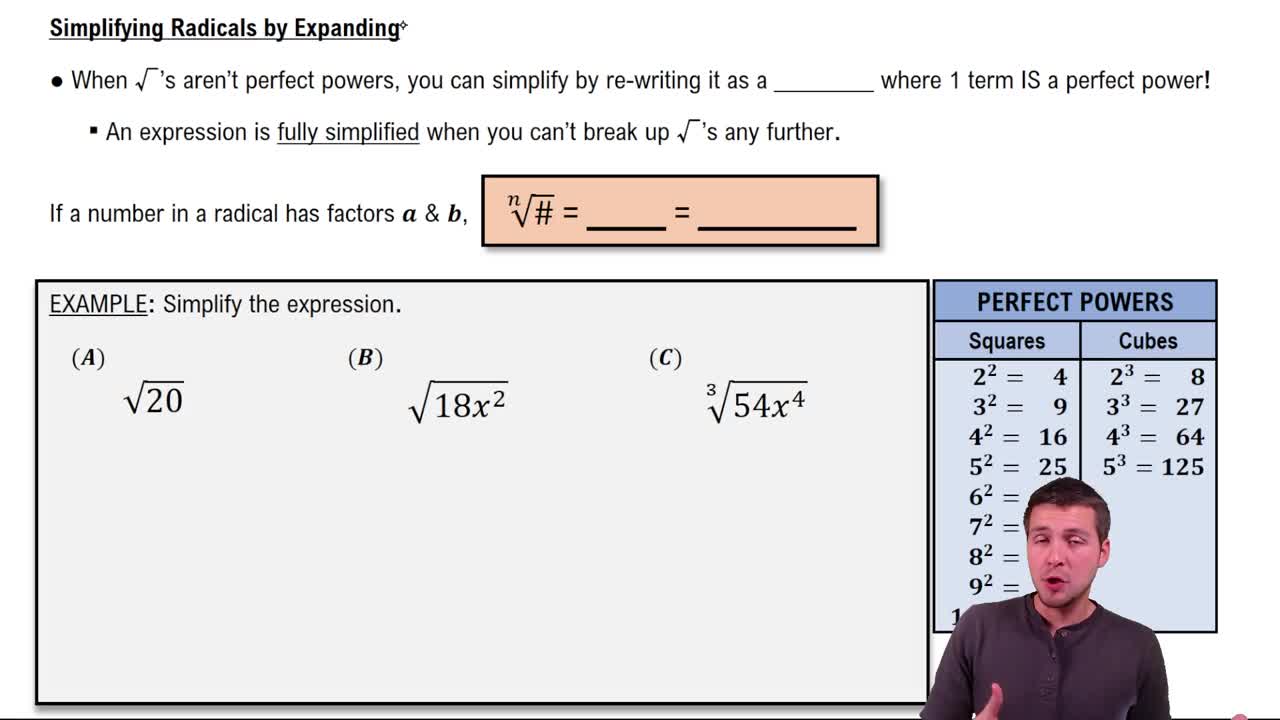
Radicals represent roots of numbers, such as cube roots (∛). Understanding how to manipulate radicals, including simplifying and multiplying them, is essential. For cube roots, the product of ∛a and ∛b equals ∛(a*b), which helps in simplifying expressions involving radicals.
Recommended video:
05:20
Expanding Radicals

Multiplying Binomials and Polynomials

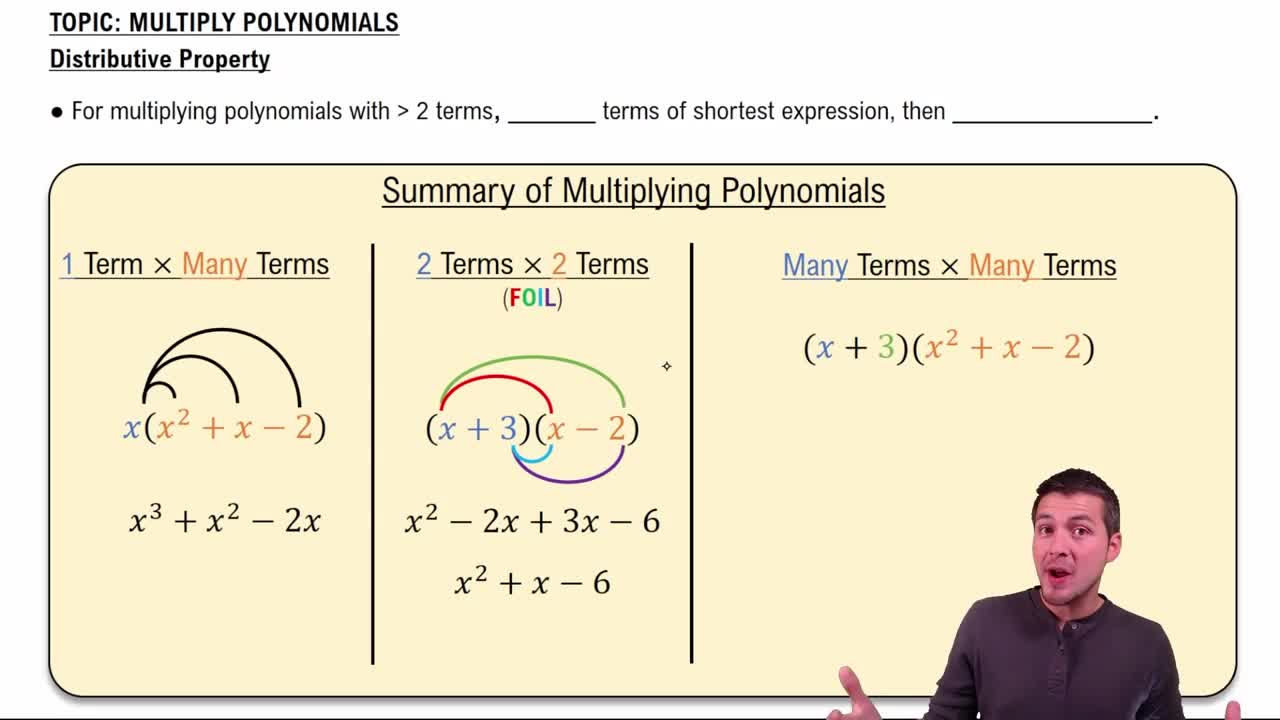
Multiplying expressions like (a - b)(c + d + e) requires applying the distributive property, multiplying each term in the first expression by each term in the second. This process expands the product into a sum of terms, which can then be combined or simplified.
Recommended video:
04:15
Multiply Polynomials Using the Distributive Property

Sum and Difference of Cubes Factorization

The expression (∛a - 1)(∛a² + ∛a + 1) is a factorization pattern for a - 1, based on the sum and difference of cubes formula: (x - y)(x² + xy + y²) = x³ - y³. Recognizing this pattern allows simplification of radical expressions by converting products into simpler forms.
Recommended video:
04:36
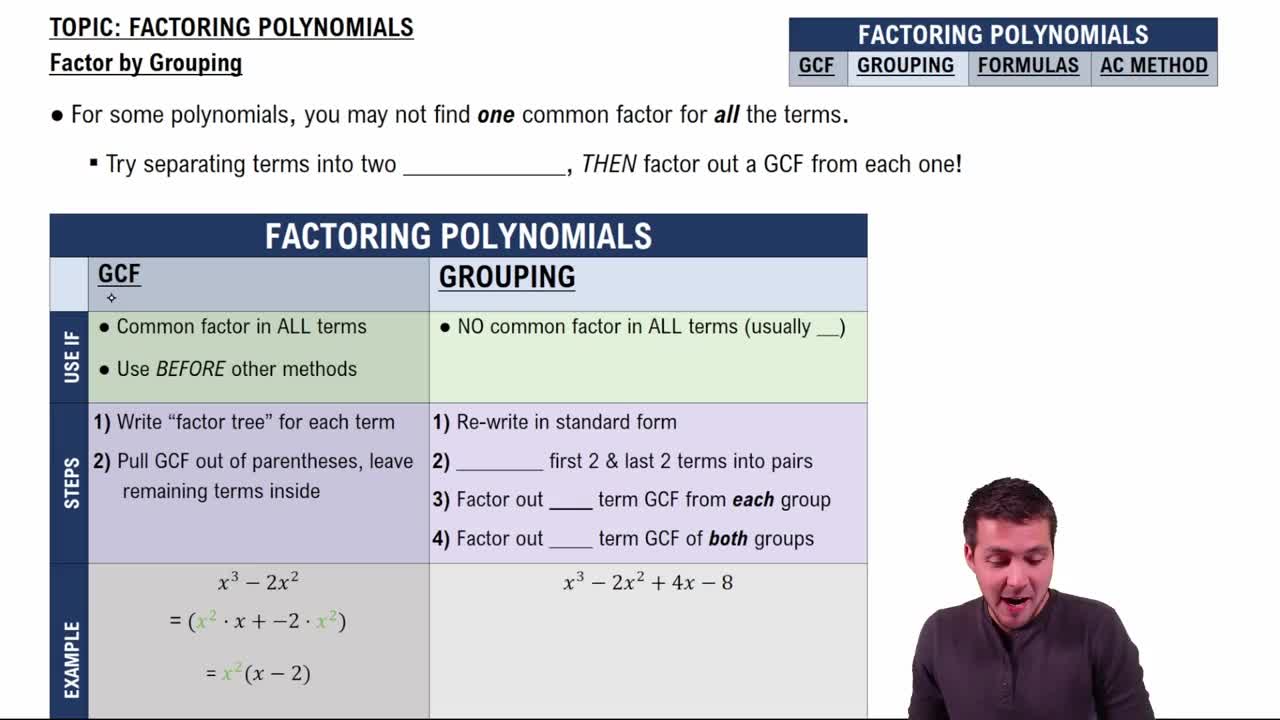
Factor by Grouping