Simplify each radical. Assume all variables represent positive real numbers.
Ch. R - Review of Basic Concepts

Chapter 1, Problem 95
Perform the indicated operations. Assume all variables represent positive real numbers. 8√(2x) - √(8x) + √(72x)
Verified step by step guidance1
Rewrite each radical expression to simplify the square roots by factoring out perfect squares. For example, express each radicand as a product of a perfect square and another factor: \(8\sqrt{2x}\), \(\sqrt{8x}\), and \(\sqrt{72x}\).
Simplify each square root separately by taking the square root of the perfect square factor out of the radical. For instance, \(\sqrt{8x} = \sqrt{4 \cdot 2x} = 2\sqrt{2x}\).
After simplifying, rewrite the entire expression with the simplified radicals. This will give you terms all involving \(\sqrt{2x}\), making it easier to combine like terms.
Combine like terms by adding or subtracting the coefficients of \(\sqrt{2x}\). Remember to keep the radical part unchanged while combining the coefficients.
Write the final simplified expression as a single term involving \(\sqrt{2x}\) with the combined coefficient.

Verified video answer for a similar problem:
This video solution was recommended by our tutors as helpful for the problem above.
Video duration:
2mWas this helpful?
Key Concepts
Here are the essential concepts you must grasp in order to answer the question correctly.
Simplifying Square Roots
Simplifying square roots involves expressing the radicand as a product of perfect squares and other factors. For example, √72x can be broken down into √(36*2*x) = 6√(2x). This process helps in combining like terms and making expressions easier to work with.
Recommended video:
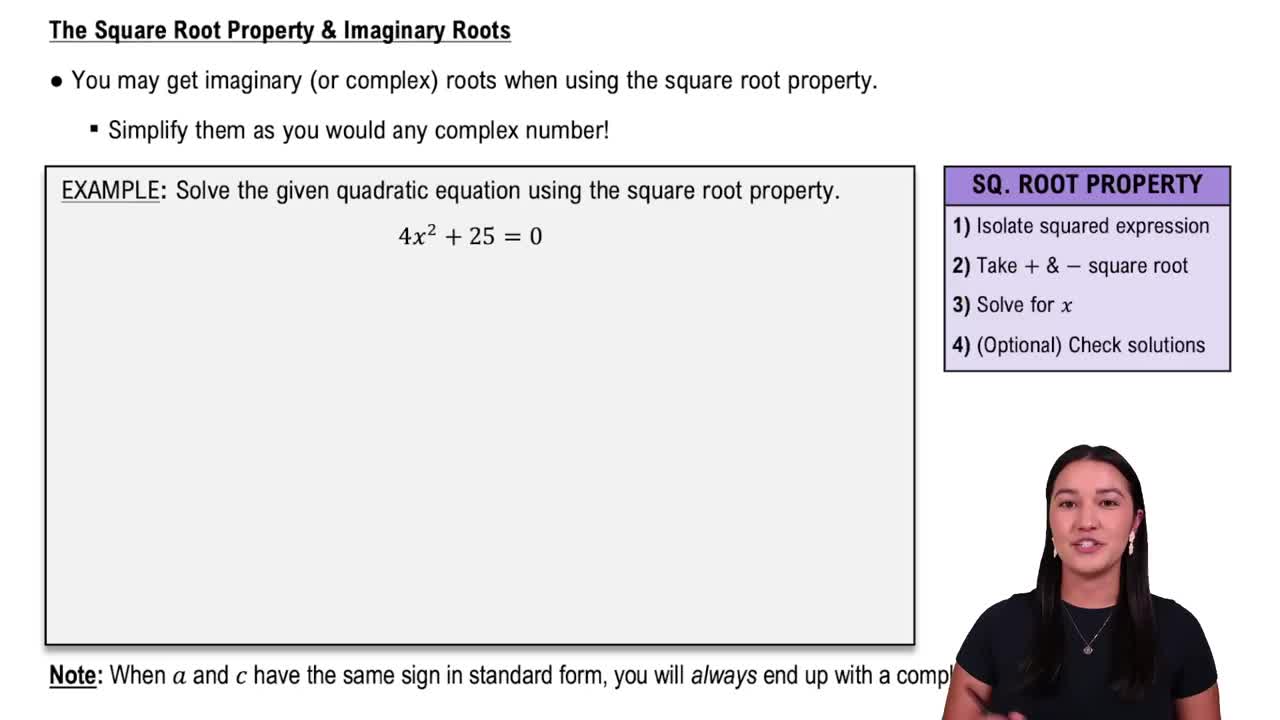
Imaginary Roots with the Square Root Property
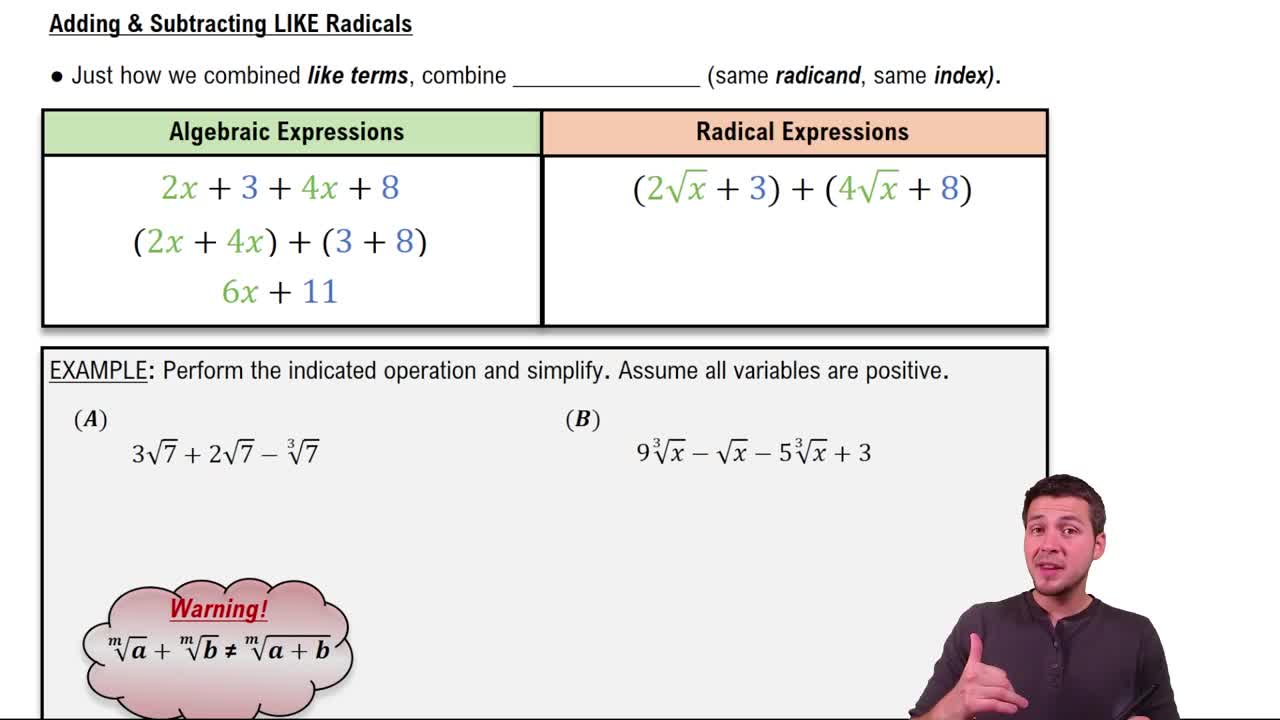
Like Terms with Radicals
Like terms in radical expressions have the same radicand. For instance, terms containing √(2x) can be combined by adding or subtracting their coefficients. Recognizing and grouping like radical terms is essential for simplifying expressions.
Recommended video:
Guided course
Adding & Subtracting Like Radicals
Operations with Radicals
Performing addition and subtraction with radicals requires first simplifying each radical and then combining like terms. Since variables represent positive real numbers, we can treat the radicals as positive quantities, ensuring valid operations without considering absolute values.
Recommended video:
Guided course
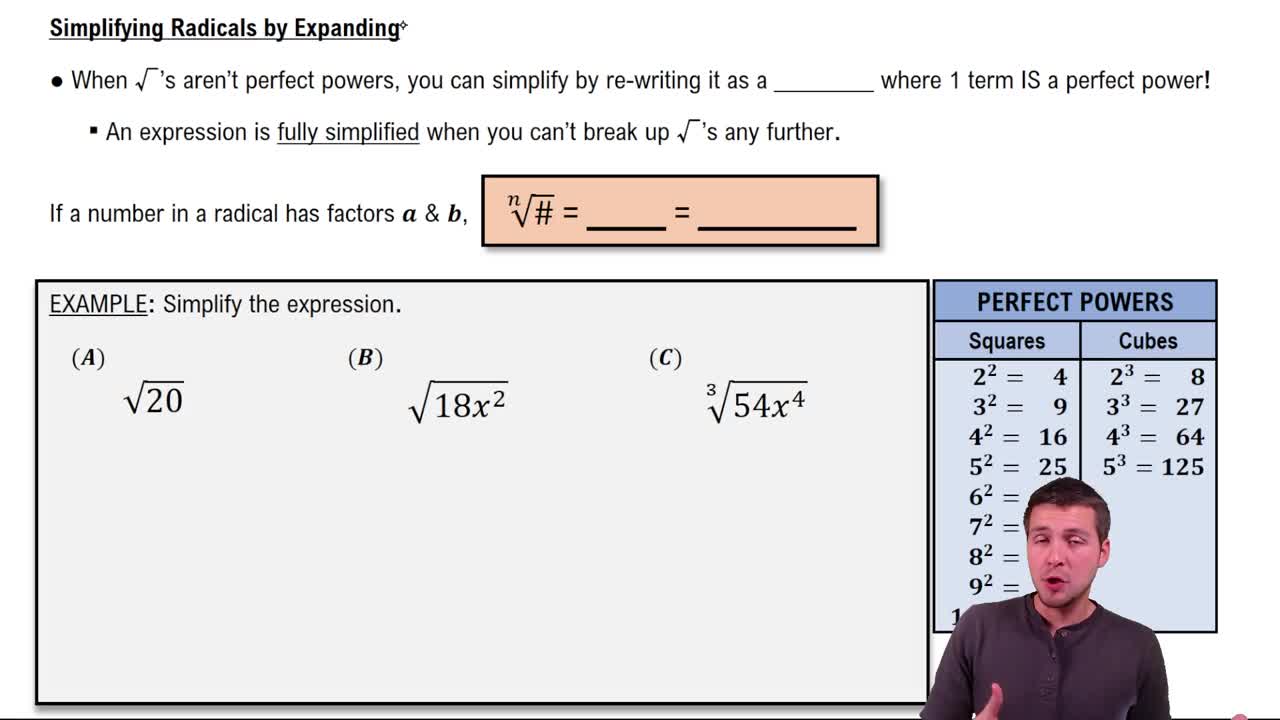
Expanding Radicals
Related Practice
Textbook Question
3
views
Textbook Question
Simplify each rational expression. Assume all variable expressions represent positive real numbers. (Hint: Use factoring and divide out any common factors as a first step.) [(x2 +1)4(2x) - x2(4)(x2+1)3(2x)] / [(x2+1)8]
Textbook Question
Evaluate each expression. (-2/9 -1/4) - {-5/18 - (-1/2)}
4
views
Textbook Question
Simplify each expression. Write answers without negative exponents. Assume all variables represent positive real numbers. (y7/3)(y-4/3)
2
views
Textbook Question
Add or subtract as indicated. 28.73 - 3.12
1
views
Textbook Question
Let U = {0, 1, 2, 3, 4, 5, 6, 7, 8, 9, 10, 11, 12, 13}, M = {0, 2, 4, 6, 8}, N = {1, 3, 5, 7, 9, 11, 13}, Q = {0, 2, 4, 6, 8, 10, 12}, and R = {0, 1, 2, 3, 4}.Use these sets to find each of the following. Identify any disjoint sets. N ∪ ∅