Let U = {0, 1, 2, 3, 4, 5, 6, 7, 8, 9, 10, 11, 12, 13}, M = {0, 2, 4, 6, 8}, N = {1, 3, 5, 7, 9, 11, 13}, Q = {0, 2, 4, 6, 8, 10, 12}, and R = {0, 1, 2, 3, 4}.Use these sets to find each of the following. Identify any disjoint sets. (M ∩ N) ∪ R
Ch. R - Review of Basic Concepts

Chapter 1, Problem 97
Perform each division. See Examples 9 and 10. (4x3+9x2-10x-6)/(4x+1)
Verified step by step guidance1
Identify the dividend and divisor: the dividend is \(4x^3 + 9x^2 - 10x - 6\) and the divisor is \(4x + 1\).
Set up polynomial long division by writing \(4x + 1\) outside the division symbol and \(4x^3 + 9x^2 - 10x - 6\) inside.
Divide the leading term of the dividend (\$4x^3\() by the leading term of the divisor (\)4x$) to find the first term of the quotient: \(\frac{4x^3}{4x} = x^2\).
Multiply the entire divisor \(4x + 1\) by \(x^2\) and subtract the result from the dividend to find the new polynomial to divide.
Repeat the process: divide the new leading term by \$4x$, multiply the divisor by this term, subtract, and continue until the degree of the remainder is less than the degree of the divisor.

Verified video answer for a similar problem:
This video solution was recommended by our tutors as helpful for the problem above.
Video duration:
5mWas this helpful?
Key Concepts
Here are the essential concepts you must grasp in order to answer the question correctly.
Polynomial Long Division
Polynomial long division is a method used to divide a polynomial by another polynomial of lower degree, similar to numerical long division. It involves dividing the leading term of the dividend by the leading term of the divisor, multiplying, subtracting, and repeating until the remainder has a lower degree than the divisor.
Recommended video:
Guided course
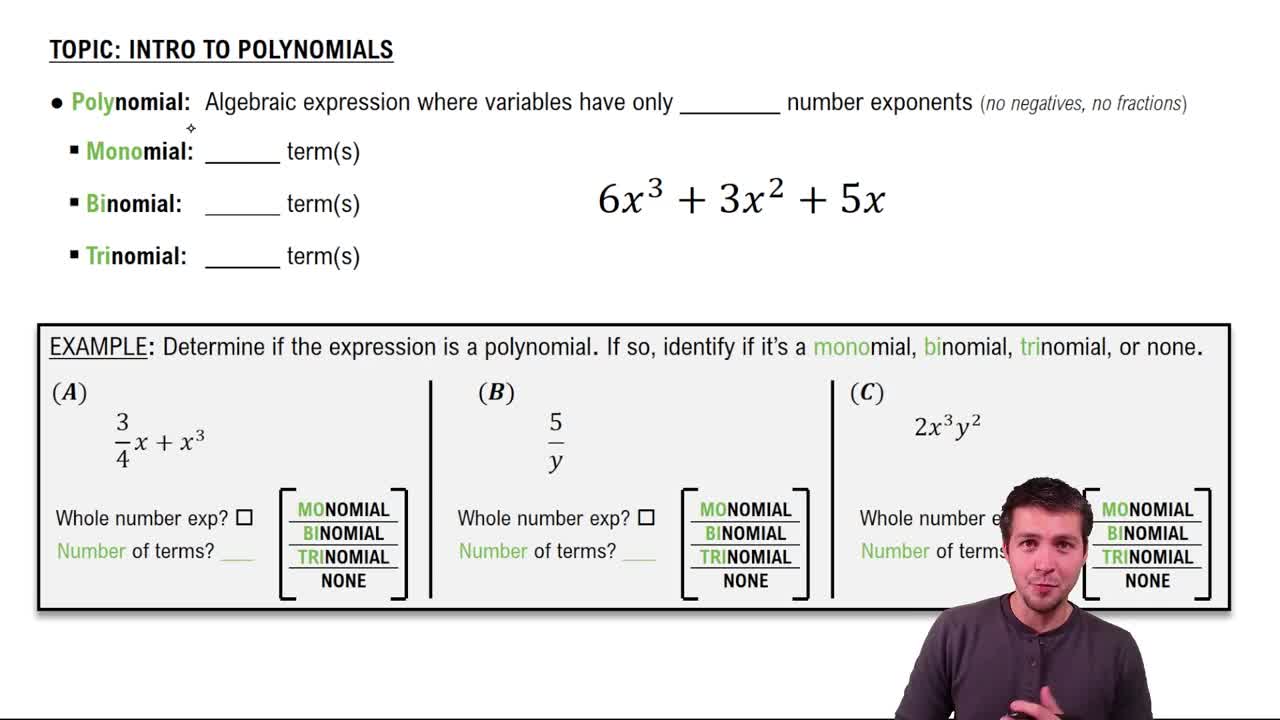
Introduction to Polynomials
Leading Terms and Degree of Polynomials
The leading term of a polynomial is the term with the highest exponent, and the degree is the highest power of the variable. Understanding these helps determine the steps in division, as the division process focuses on reducing the degree of the dividend by matching leading terms with the divisor.
Recommended video:
Guided course
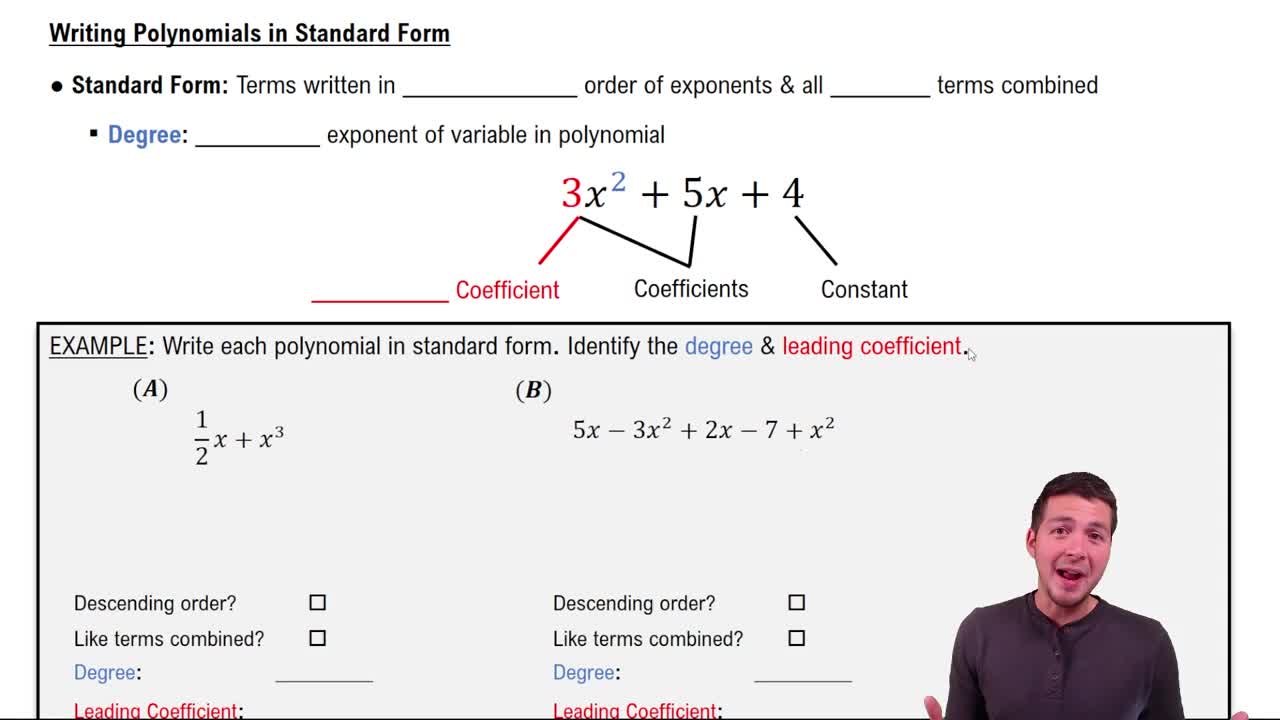
Standard Form of Polynomials
Remainder and Quotient in Polynomial Division
When dividing polynomials, the quotient is the result of the division, and the remainder is what is left when the division cannot continue because the degree of the remainder is less than the divisor. The division can be expressed as Dividend = Divisor × Quotient + Remainder.
Recommended video:
Guided course
Introduction to Polynomials
Related Practice
Textbook Question
Textbook Question
Evaluate each expression.
3
views
Textbook Question
Simplify each expression. Write answers without negative exponents. Assume all variables represent positive real numbers. (z3/4)/(z5/4)(z-2)
2
views
Textbook Question
Simplify each rational expression. Assume all variable expressions represent positive real numbers. (Hint: Use factoring and divide out any common factors as a first step.) [4(x2- 1)3 + 8x(x2-1)4] / [16(x2-1)3]
3
views
Textbook Question
Factor by any method. See Examples 1–7. x2+xy-5x-5y
Textbook Question
Perform the indicated operations. Assume all variables represent positive real numbers.
6
views