Ch. R - Review of Basic Concepts
Lial - College Algebra 13th Edition
Lial13th EditionCollege AlgebraISBN: 9780136881063Not the one you use?Change textbook
Chapter 1, Problem 104

Let U = {0, 1, 2, 3, 4, 5, 6, 7, 8, 9, 10, 11, 12, 13}, M = {0, 2, 4, 6, 8}, N = {1, 3, 5, 7, 9, 11, 13}, Q = {0, 2, 4, 6, 8, 10, 12}, and R = {0, 1, 2, 3, 4}.Use these sets to find each of the following. Identify any disjoint sets. (U ∩ ∅′) ∪ R

Verified step by step guidance
1
Step 1: Understand the universal set U and the empty set ∅. The universal set U contains all elements under consideration, and the empty set ∅ has no elements. The complement of the empty set, denoted as ∅′, is the set of all elements in U that are not in ∅. Since ∅ has no elements, ∅′ = U.
Step 2: Calculate the intersection of U and ∅′, which is U ∩ ∅′. Since ∅′ = U, the intersection U ∩ ∅′ is simply U itself.
Step 3: Recall the set R = {0, 1, 2, 3, 4}. The problem asks for (U ∩ ∅′) ∪ R, which simplifies to U ∪ R because U ∩ ∅′ = U.
Step 4: Since U contains all elements from 0 to 13, and R is a subset of U, the union U ∪ R is just U. So the resulting set is U = {0, 1, 2, 3, 4, 5, 6, 7, 8, 9, 10, 11, 12, 13}.
Step 5: To identify any disjoint sets among the given sets, recall that two sets are disjoint if they have no elements in common. Check pairs such as M and N, M and Q, N and R, etc., by comparing their elements to see if their intersection is empty.

Verified video answer for a similar problem:

This video solution was recommended by our tutors as helpful for the problem above.
Video duration:
4m
Was this helpful?

Key Concepts

Here are the essential concepts you must grasp in order to answer the question correctly.

Universal Set and Subsets

The universal set U contains all elements under consideration, while subsets like M, N, Q, and R are parts of U. Understanding the relationship between the universal set and its subsets helps in performing set operations and interpreting results within the defined context.
Recommended video:
05:18
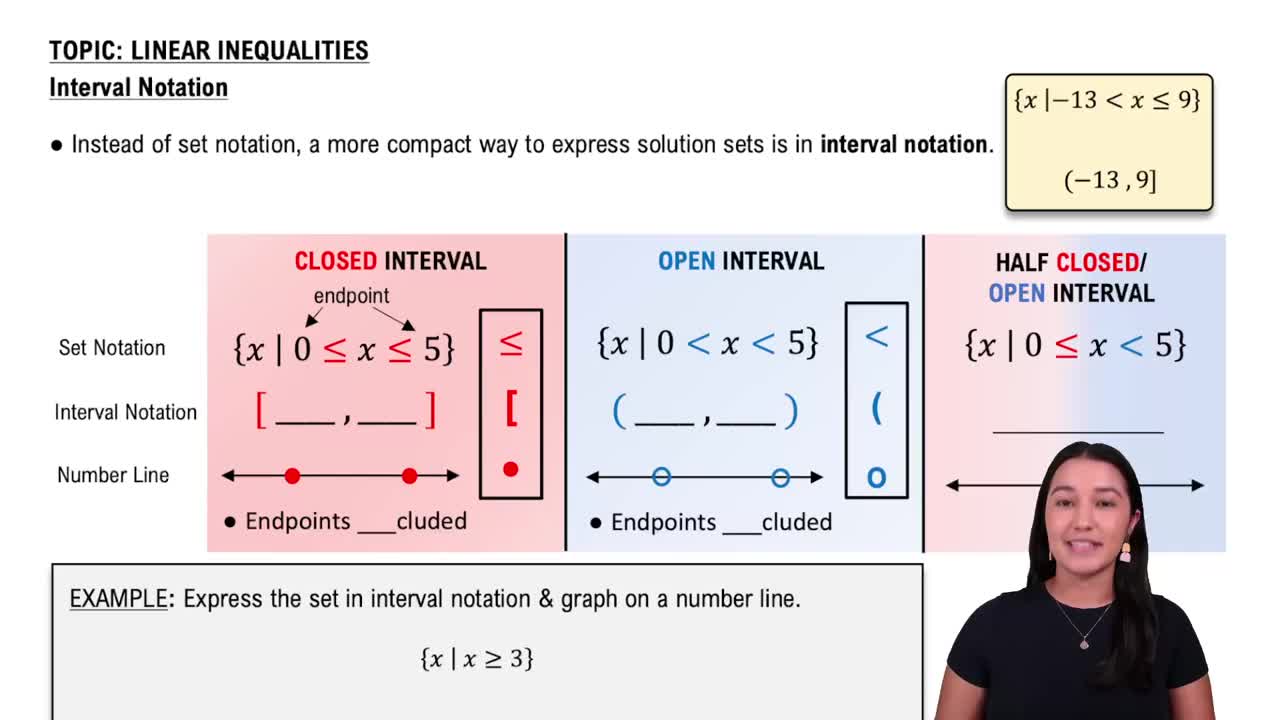
Interval Notation

Set Complement

The complement of a set, denoted by ∅′, includes all elements in the universal set that are not in the given set. Since ∅ is the empty set, its complement is the entire universal set U. Recognizing complements is essential for correctly evaluating expressions involving complements.
Recommended video:
4:23
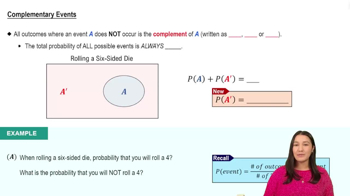
Complementary Events

Set Operations: Intersection and Union

Intersection (∩) finds common elements between sets, while union (∪) combines all elements from the involved sets without duplication. Applying these operations step-by-step allows for simplifying complex set expressions and identifying relationships such as disjointness.
Recommended video:
Guided course
8:38
Performing Row Operations on Matrices