Ch. R - Review of Basic Concepts
Lial - College Algebra 13th Edition
Lial13th EditionCollege AlgebraISBN: 9780136881063Not the one you use?Change textbook
Chapter 1, Problem 140

Find all values of b or c that will make the polynomial a perfect square trinomial. 49x2+70x+c

Verified step by step guidance
1
Recognize that a perfect square trinomial takes the form \(\left( dx + e \right)^2 = d^2x^2 + 2dex + e^2\). Our goal is to express \(49x^2 + 70x + c\) in this form.
Identify the coefficient of \(x^2\) in the given polynomial, which is 49. Since \(d^2 = 49\), solve for \(d\) by taking the square root: \(d = \pm 7\).
Use the middle term \$70x\( to find \)e\(. Recall that the middle term in the perfect square trinomial is \)2de x\(. Substitute \)d = 7$ (choosing the positive root for simplicity) and set \(2 \times 7 \times e = 70\).
Solve for \(e\) from the equation \(14e = 70\), which gives \(e = 5\).
Find \(c\) by calculating \(e^2\), since the constant term in the perfect square trinomial is \(e^2\). Therefore, \(c = 5^2 = 25\).

Verified video answer for a similar problem:

This video solution was recommended by our tutors as helpful for the problem above.
Video duration:
2m
Was this helpful?

Key Concepts

Here are the essential concepts you must grasp in order to answer the question correctly.

Perfect Square Trinomial

A perfect square trinomial is a quadratic expression that can be factored into the square of a binomial, typically in the form (mx + n)^2. It expands to m^2x^2 + 2mnx + n^2, where the middle term is twice the product of the square roots of the first and last terms.
Recommended video:
06:24
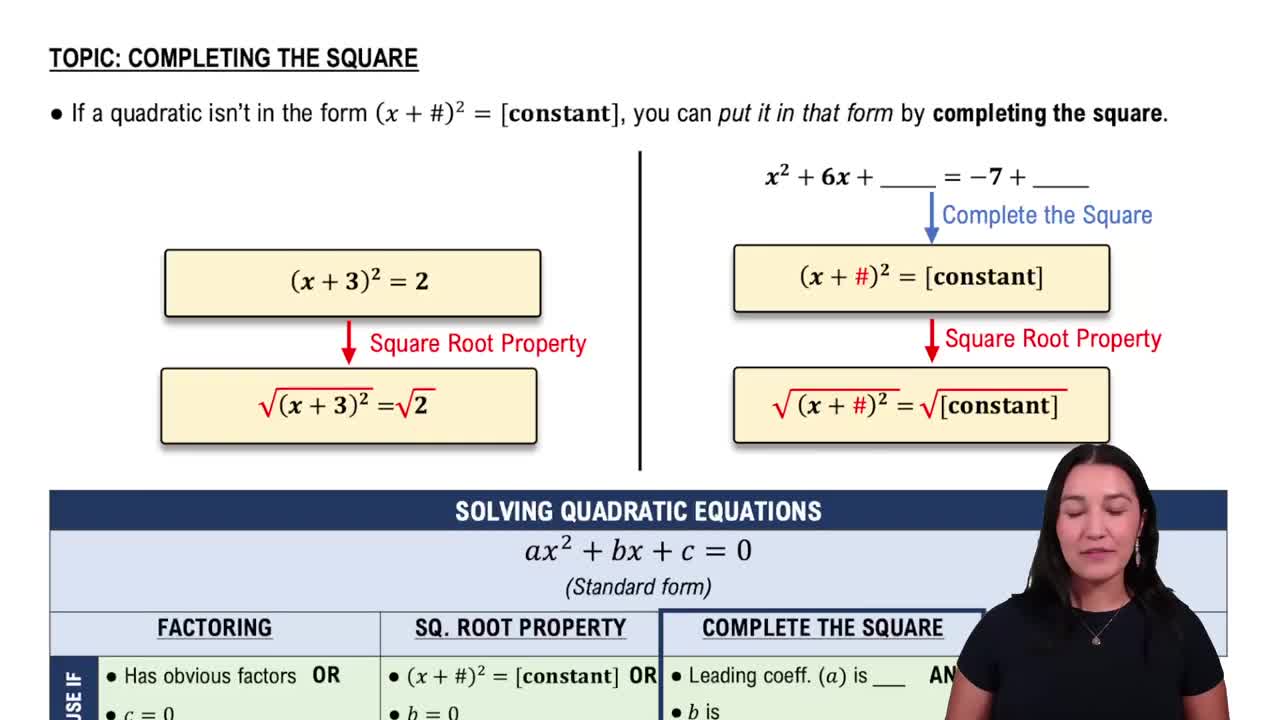
Solving Quadratic Equations by Completing the Square

Identifying Coefficients in a Quadratic

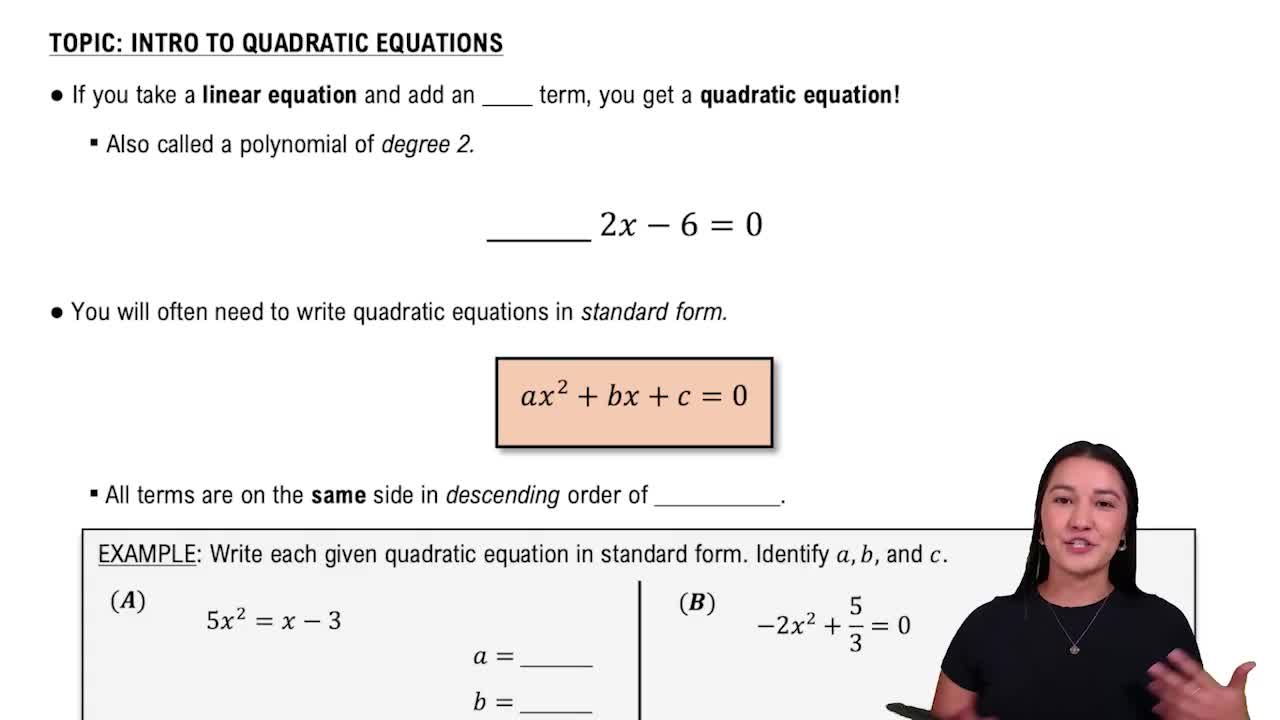
In a quadratic expression ax^2 + bx + c, the coefficients a, b, and c represent the quadratic, linear, and constant terms respectively. Understanding their roles helps in comparing the given polynomial to the standard form of a perfect square trinomial to find missing values.
Recommended video:
05:35
Introduction to Quadratic Equations

Using the Relationship Between Coefficients for Perfect Squares

For a trinomial to be a perfect square, the constant term c must equal (b/2)^2 when the leading coefficient a is 1, or more generally, c = (b/(2a))^2 * a. This relationship allows solving for unknown coefficients to ensure the polynomial is a perfect square.
Recommended video:
06:24
Solving Quadratic Equations by Completing the Square