Ch. R - Review of Basic Concepts
Lial - College Algebra 13th Edition
Lial13th EditionCollege AlgebraISBN: 9780136881063Not the one you use?Change textbook
Chapter 1, Problem 9

Find {16, 18, 21, 50} ∪ {15, 16, 17, 18}.

Verified step by step guidance
1
Understand that the union of two sets, denoted by \(A \cup B\), is the set containing all elements that are in \(A\), or in \(B\), or in both.
Identify the two sets given: \(A = \{16, 18, 21, 50\}\) and \(B = \{15, 16, 17, 18\}\).
List all elements from set \(A\): \$16, 18, 21, 50$.
Add all elements from set \(B\) that are not already in set \(A\): \$15, 17$ (since \(16\) and \(18\) are already included).
Combine all unique elements to form the union: \(\{15, 16, 17, 18, 21, 50\}\).

Verified video answer for a similar problem:

This video solution was recommended by our tutors as helpful for the problem above.
Video duration:
1m
Was this helpful?

Key Concepts

Here are the essential concepts you must grasp in order to answer the question correctly.

Set Theory

Set theory studies collections of distinct objects, called sets. It provides the foundation for understanding operations like union, intersection, and difference between sets, which are essential for solving problems involving groups of elements.
Recommended video:
05:18
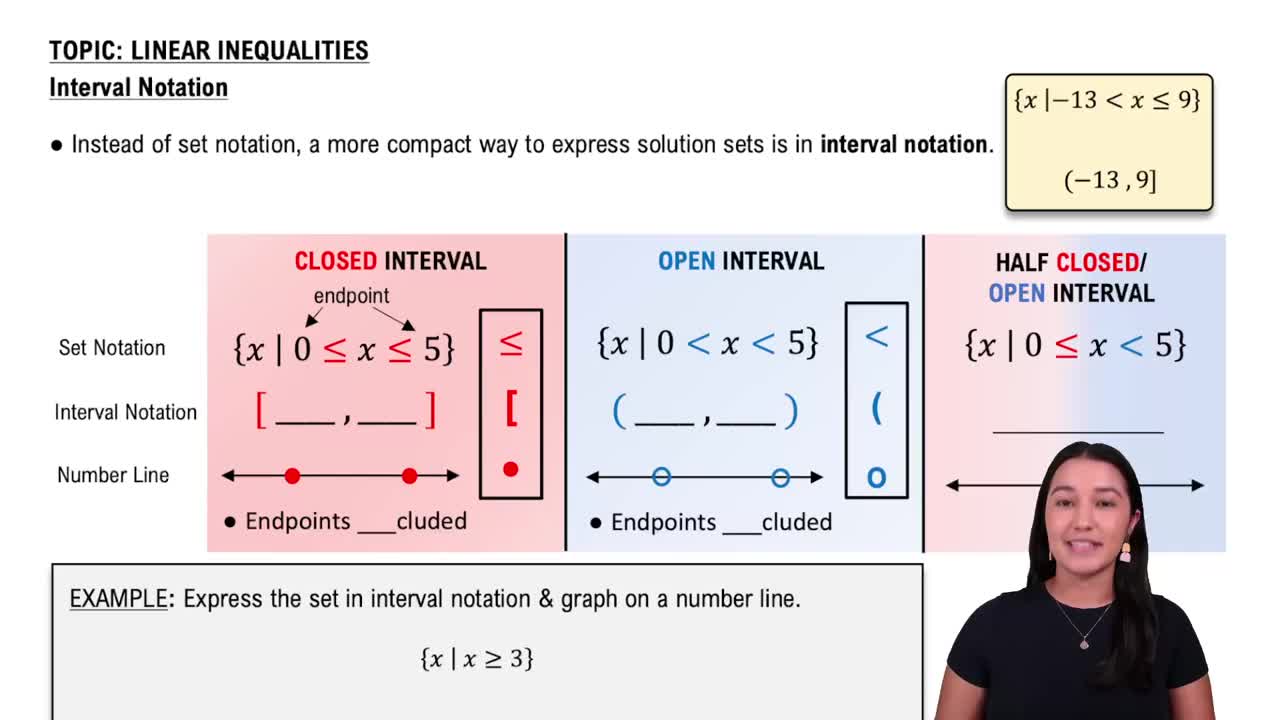
Interval Notation

Union of Sets

The union of two sets combines all unique elements from both sets into one set. It is denoted by the symbol ∪ and includes every element that appears in either or both sets, without duplication.
Recommended video:
5:10
Finding the Domain and Range of a Graph

Element Uniqueness in Sets

In sets, each element is unique and appears only once, regardless of how many times it is listed. When performing operations like union, repeated elements are counted only once to maintain the set's property of distinctness.
Recommended video:
3:08
Geometries from Conic Sections