Multiply or divide as indicated. 12.8 × 9.1
Ch. R - Review of Basic Concepts

Chapter 1, Problem 106
Factor by any method. See Examples 1–7.
Verified step by step guidance1
Recognize that the expression \(q^2 + 6q + 9 - p^2\) can be viewed as a difference of two parts: \((q^2 + 6q + 9)\) and \(p^2\).
Notice that \(q^2 + 6q + 9\) is a perfect square trinomial because it matches the form \(a^2 + 2ab + b^2\), where \(a = q\) and \(b = 3\), so it factors as \((q + 3)^2\).
Rewrite the original expression as \((q + 3)^2 - p^2\) to clearly see it as a difference of squares.
Apply the difference of squares formula, which states that \(A^2 - B^2 = (A - B)(A + B)\), where \(A = (q + 3)\) and \(B = p\).
Write the factored form as \(((q + 3) - p)((q + 3) + p)\).

Verified video answer for a similar problem:
This video solution was recommended by our tutors as helpful for the problem above.
Video duration:
5mWas this helpful?
Key Concepts
Here are the essential concepts you must grasp in order to answer the question correctly.
Factoring Quadratic Trinomials
Factoring quadratic trinomials involves expressing a quadratic expression like q² + 6q + 9 as a product of two binomials. Recognizing perfect square trinomials, where the first and last terms are perfect squares and the middle term is twice the product of their roots, helps simplify the process.
Recommended video:
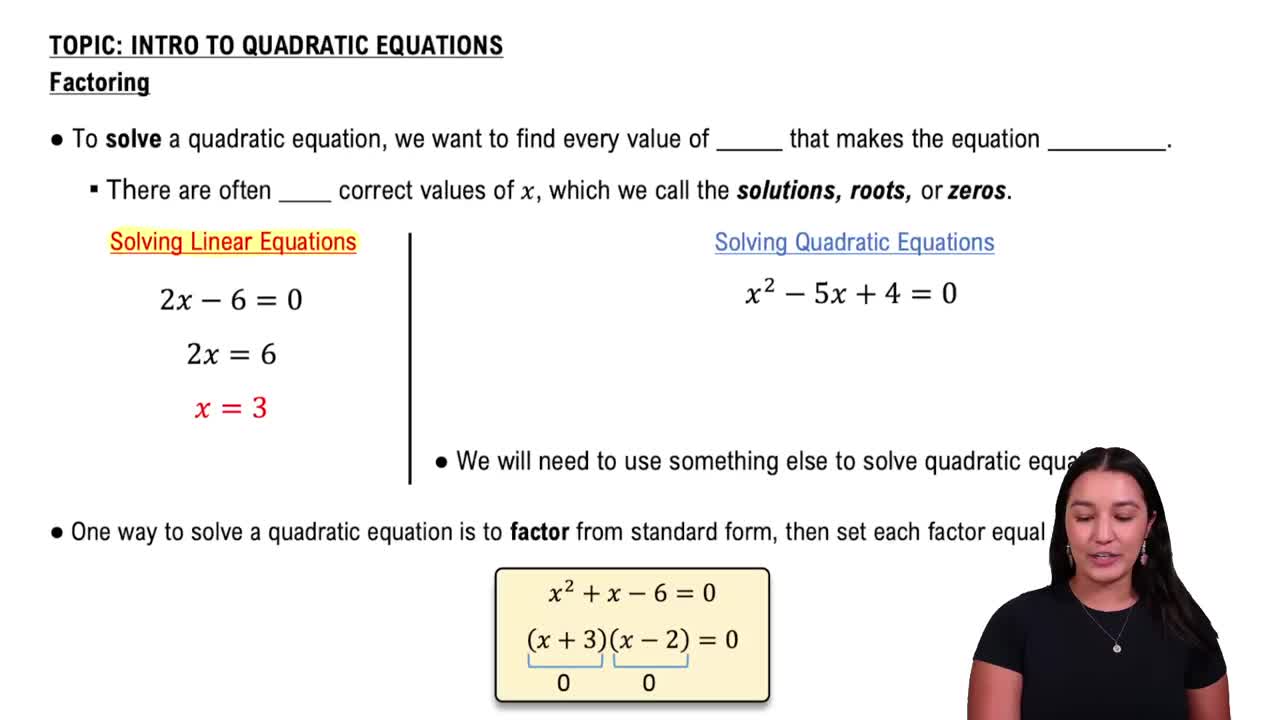
Solving Quadratic Equations by Factoring
Difference of Squares
The difference of squares is a factoring technique used when an expression is in the form a² - b². It factors into (a - b)(a + b). Identifying this pattern allows for quick simplification of expressions like (q + 3)² - p².
Recommended video:
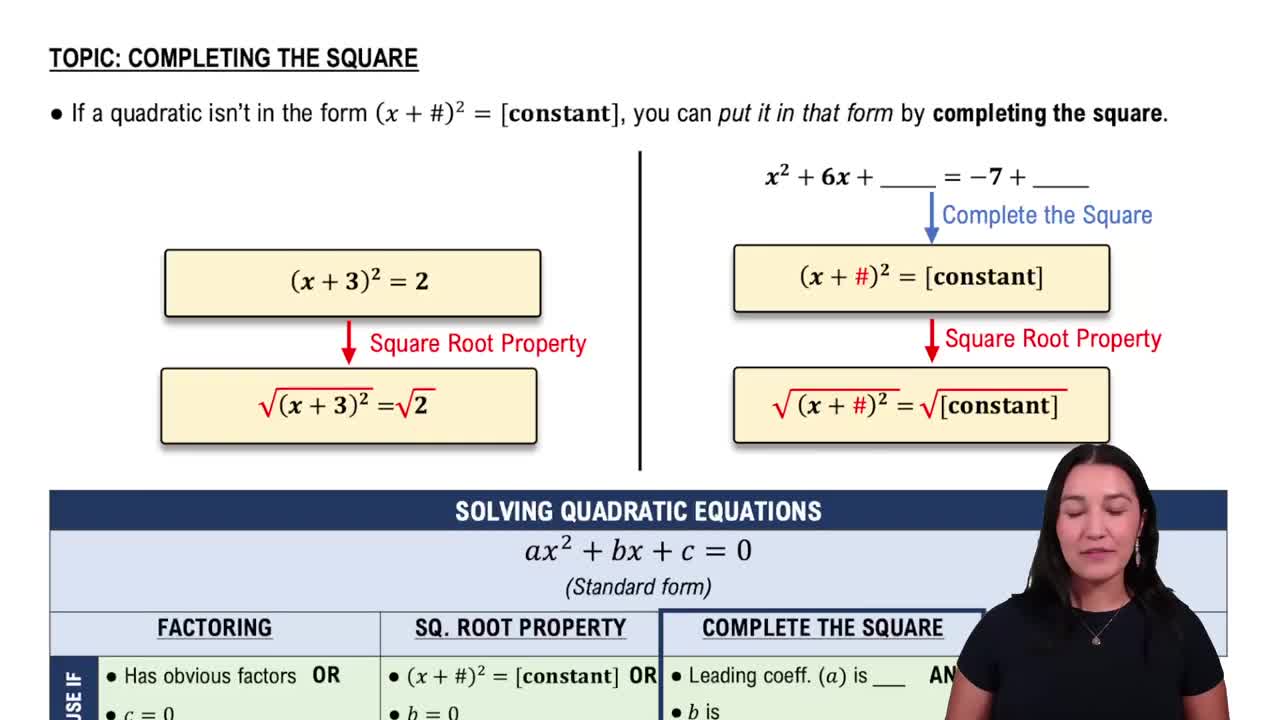
Solving Quadratic Equations by Completing the Square
Combining Factoring Methods
Some expressions require multiple factoring methods applied sequentially. For example, first factoring a perfect square trinomial, then applying the difference of squares formula. Understanding how to combine these techniques is essential for fully factoring complex expressions.
Recommended video:
Guided course
Factor Using the AC Method When a Is 1
Related Practice
Textbook Question
2
views
Textbook Question
Let U = {0, 1, 2, 3, 4, 5, 6, 7, 8, 9, 10, 11, 12, 13}, M = {0, 2, 4, 6, 8}, N = {1, 3, 5, 7, 9, 11, 13}, Q = {0, 2, 4, 6, 8, 10, 12}, and R = {0, 1, 2, 3, 4}.Use these sets to find each of the following. Identify any disjoint sets. {x | x ∈ M and x ∈ Q}
Textbook Question
Multiply or divide as indicated. 34.04 × 0.56
1
views
Textbook Question
Let U = {0, 1, 2, 3, 4, 5, 6, 7, 8, 9, 10, 11, 12, 13}, M = {0, 2, 4, 6, 8}, N = {1, 3, 5, 7, 9, 11, 13}, Q = {0, 2, 4, 6, 8, 10, 12}, and R = {0, 1, 2, 3, 4}.Use these sets to find each of the following. Identify any disjoint sets. {x | x ∈ U, x ∉ R}
Textbook Question
Evaluate each expression for , , and .
2
views
Textbook Question
Simplify each expression. Write answers without negative exponents. Assume all variables represent positive real numbers. (z1/3z-2/3z1/6)/(z-1/6)3
2
views
