Perform the indicated operations. Assume all variables represent positive real numbers.
Ch. R - Review of Basic Concepts

Chapter 1, Problem 99
Factor by any method. See Examples 1–7. p4(m-2n)+q(m-2n)
Verified step by step guidance1
Identify the common factor in both terms of the expression \(p^4(m-2n) + q(m-2n)\). Notice that \((m-2n)\) appears in both terms.
Factor out the common binomial factor \((m-2n)\) from the expression. This gives you \((m-2n)(p^4 + q)\).
Check the remaining factor inside the parentheses, \(p^4 + q\), to see if it can be factored further. Since \(p^4 + q\) is a sum of terms with no common factors and no special factoring formulas apply, it remains as is.
Write the fully factored form as the product of the common factor and the remaining expression: \((m-2n)(p^4 + q)\).
Verify your factorization by expanding the product to ensure it matches the original expression.

Verified video answer for a similar problem:
This video solution was recommended by our tutors as helpful for the problem above.
Video duration:
1mWas this helpful?
Key Concepts
Here are the essential concepts you must grasp in order to answer the question correctly.
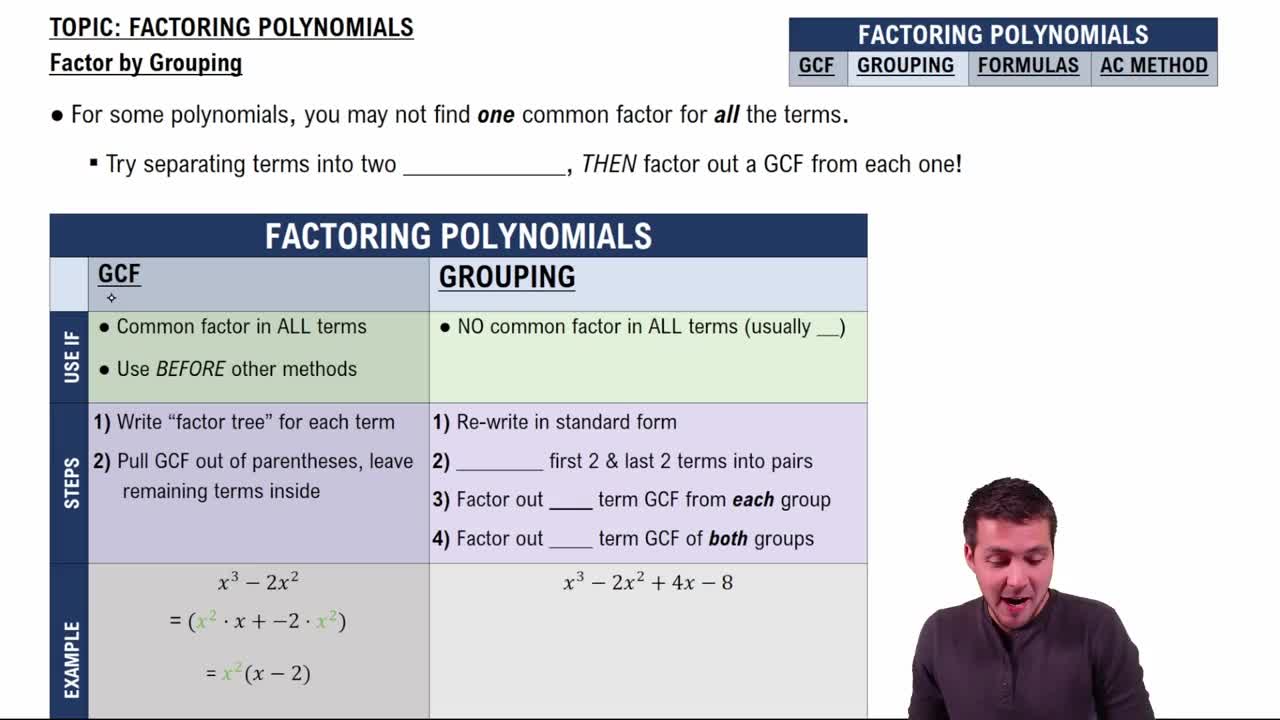
Factoring by Grouping
Factoring by grouping involves rearranging and grouping terms in an expression to find common factors within each group. This method helps simplify complex polynomials by breaking them into smaller parts that share common factors, making it easier to factor the entire expression.
Recommended video:
Guided course
Factor by Grouping
Common Factor Extraction
Common factor extraction is the process of identifying and factoring out the greatest common factor (GCF) from all terms in an expression. This simplifies the expression and is often the first step in factoring polynomials, as seen when terms share a binomial like (m - 2n).
Recommended video:
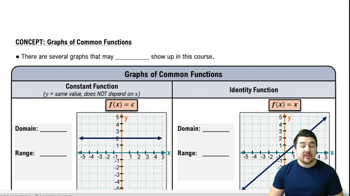
Graphs of Common Functions
Polynomial Expressions and Exponents
Understanding polynomial expressions and the role of exponents is essential for factoring. Recognizing powers, such as p^4, helps in identifying common bases and applying exponent rules, which is crucial when factoring terms with variables raised to powers.
Recommended video:
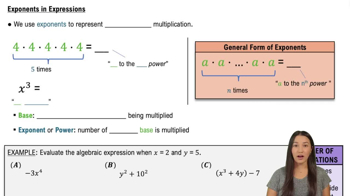
Introduction to Exponents
Related Practice
Textbook Question
2
views
Textbook Question
Simplify each rational expression. Assume all variable expressions represent positive real numbers. (Hint: Use factoring and divide out any common factors as a first step.) [2(2x-3)1/3 - (x-1)(2x-3)-2/3] / [(2x-2)-2/3]
2
views
Textbook Question
Perform each division. See Examples 9 and 10. (4x3-3x2+1)/(x-2)
1
views
Textbook Question
Add or subtract as indicated. 3.87 + 15 + 2.9
Textbook Question
Let U = {0, 1, 2, 3, 4, 5, 6, 7, 8, 9, 10, 11, 12, 13}, M = {0, 2, 4, 6, 8}, N = {1, 3, 5, 7, 9, 11, 13}, Q = {0, 2, 4, 6, 8, 10, 12}, and R = {0, 1, 2, 3, 4}.Use these sets to find each of the following. Identify any disjoint sets. (R ∪ N) ∩ M′
1
views
Textbook Question
Simplify each expression. Write answers without negative exponents. Assume all variables represent positive real numbers. (x1/4y2/5)20/x2
2
views