Ch. R - Review of Basic Concepts
Lial - College Algebra 13th Edition
Lial13th EditionCollege AlgebraISBN: 9780136881063Not the one you use?Change textbook
Chapter 1, Problem 103

Factor by any method. See Examples 1–7. 1000x3+343y31000x^3+343y^3

Verified step by step guidance
1
Recognize that the expression \(1000x^3 + 343y^3\) is a sum of cubes because \(1000x^3 = (10x)^3\) and \(343y^3 = (7y)^3\).
Recall the sum of cubes factoring formula: $a^3 + b^3 = (a + b)(a^2 - ab + b^2)$.
Identify \(a = 10x\) and \(b = 7y\) in the given expression.
Apply the formula by substituting \(a\) and \(b\): write the factorization as \((10x + 7y)((10x)^2 - (10x)(7y) + (7y)^2)\).
Simplify the terms inside the second factor: calculate \((10x)^2\), \((10x)(7y)\), and \((7y)^2\) to complete the factorization.

Verified video answer for a similar problem:

This video solution was recommended by our tutors as helpful for the problem above.
Video duration:
3m

Key Concepts

Here are the essential concepts you must grasp in order to answer the question correctly.

Sum of Cubes Formula

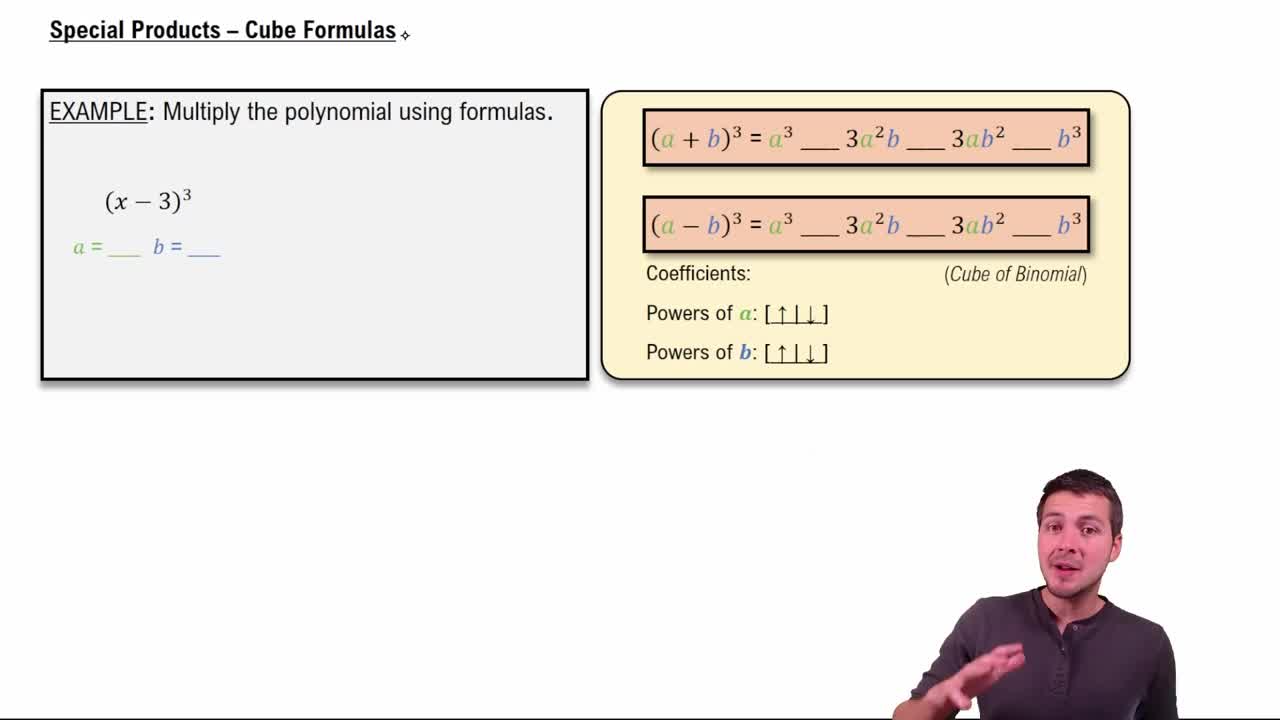
The sum of cubes formula states that a³ + b³ = (a + b)(a² - ab + b²). This formula is used to factor expressions where two terms are each perfect cubes added together. Recognizing 1000x³ and 343y³ as cubes allows applying this formula directly.
Recommended video:
03:41
Special Products - Cube Formulas

Identifying Perfect Cubes

A perfect cube is a number or expression raised to the third power, such as 1000 = 10³ and 343 = 7³. Identifying each term as a perfect cube is essential before applying the sum of cubes formula, ensuring the expression fits the pattern a³ + b³.
Recommended video:
03:41
Special Products - Cube Formulas

Factoring Polynomials

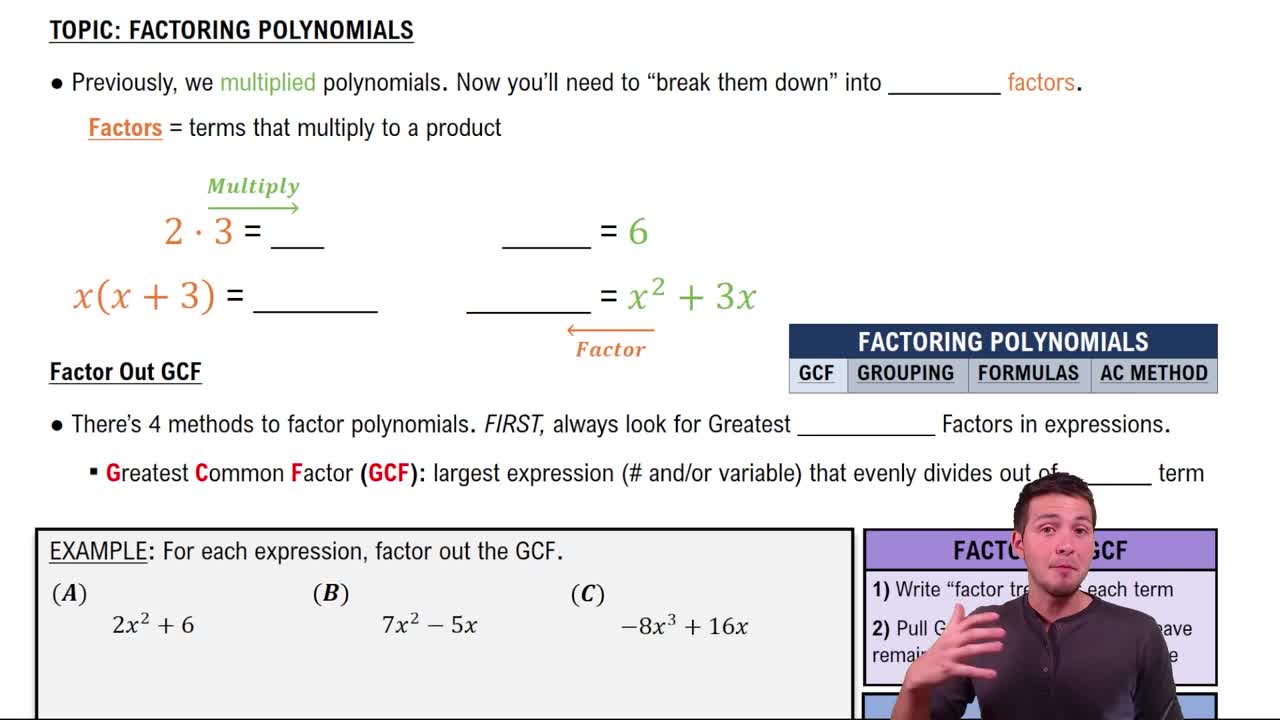
Factoring polynomials involves rewriting an expression as a product of simpler polynomials. Using special formulas like the sum of cubes helps break down complex expressions into factors, which can simplify solving equations or further algebraic manipulation.
Recommended video:
07:30
Introduction to Factoring Polynomials